
Gemini Nano On-Device AI vs Cloud LLMs: The Future of Smartphone Intelligence
Estimated reading time: 8 minutes
Key Takeaways
- On-device AI, like Google’s Gemini Nano, processes data locally on your phone, offering near-instant responses, enhanced privacy, and offline functionality.
- Cloud LLMs (like a hypothetical GPT-5) represent the peak of raw power and knowledge but introduce network latency, API costs, and data privacy considerations.
- The core trade-off is clear: Cloud for scale and depth, on-device for speed and privacy.
- Real-world performance, as seen on the Pixel 10 Pro, shows on-device AI achieving speeds of nearly 1000 tokens/second for specific tasks.
- The future is a hybrid model, where your smartphone intelligently splits tasks between its local AI and the cloud for a seamless, powerful experience.
Table of contents
- Gemini Nano On-Device AI vs Cloud LLMs: The Future of Smartphone Intelligence
- Key Takeaways
- The AI Crossroads: Cloud Giants vs. Pocket Power
- Understanding the Contenders
- The Hardware Engine: From Tensor G4 to Next-Gen Chips
- Pixel 10 Pro & Next-Gen Tensor Performance Analysis
- Gemini Nano Speed & Efficiency Review
- Real-World Use Cases: Where Each Paradigm Wins
- Beyond Speed: Privacy, Cost, and Accessibility
- The Future of On-Device AI in Smartphones
- Frequently Asked Questions
The AI Crossroads: Cloud Giants vs. Pocket Power
For years, the narrative of artificial intelligence has been written in the cloud. Massive data centers, housing models with hundreds of billions of parameters, have delivered astonishing capabilities—from drafting essays to generating images—all at the cost of a network request. But a quiet, rapid revolution is happening in your pocket. The era of capable, efficient on-device AI is here, challenging the cloud’s dominance for everyday tasks.
This brings us to the central question of this analysis: gemini nano on-device ai vs cloud llms. Which approach wins? The answer isn’t simple, because they’re built for different battles. This post provides a detailed, technical comparison of performance, efficiency, privacy, and real-world use cases between these two paradigms. We’ll use Google’s Gemini Nano as our case study for the on-device frontier and a hypothetical next-generation model like GPT-5 to represent the cutting edge of cloud LLMs, illustrating the fundamental trade-offs shaping the future of computing.

Understanding the Contenders
On-Device AI & Gemini Nano Explained
On-device AI refers to models that perform inference—the actual processing and generation of responses—locally on your device (smartphone, laptop, browser) without sending your data to a remote server. This fundamental shift is key to understanding its advantages. As explored by developers, this architecture unlocks new possibilities for responsiveness and privacy.
At the forefront of this movement is Gemini Nano, Google’s flagship on-device large language model designed to run directly on smartphones and in browsers like Chrome. It represents a pivotal step in making advanced AI a native feature of your device. It sits as the most efficient tier in the Gemini family (alongside Ultra, Pro, and Flash), specifically distilled and optimized for local execution where power and thermal constraints are paramount. This distillation process is crucial for packing capability into a small footprint.
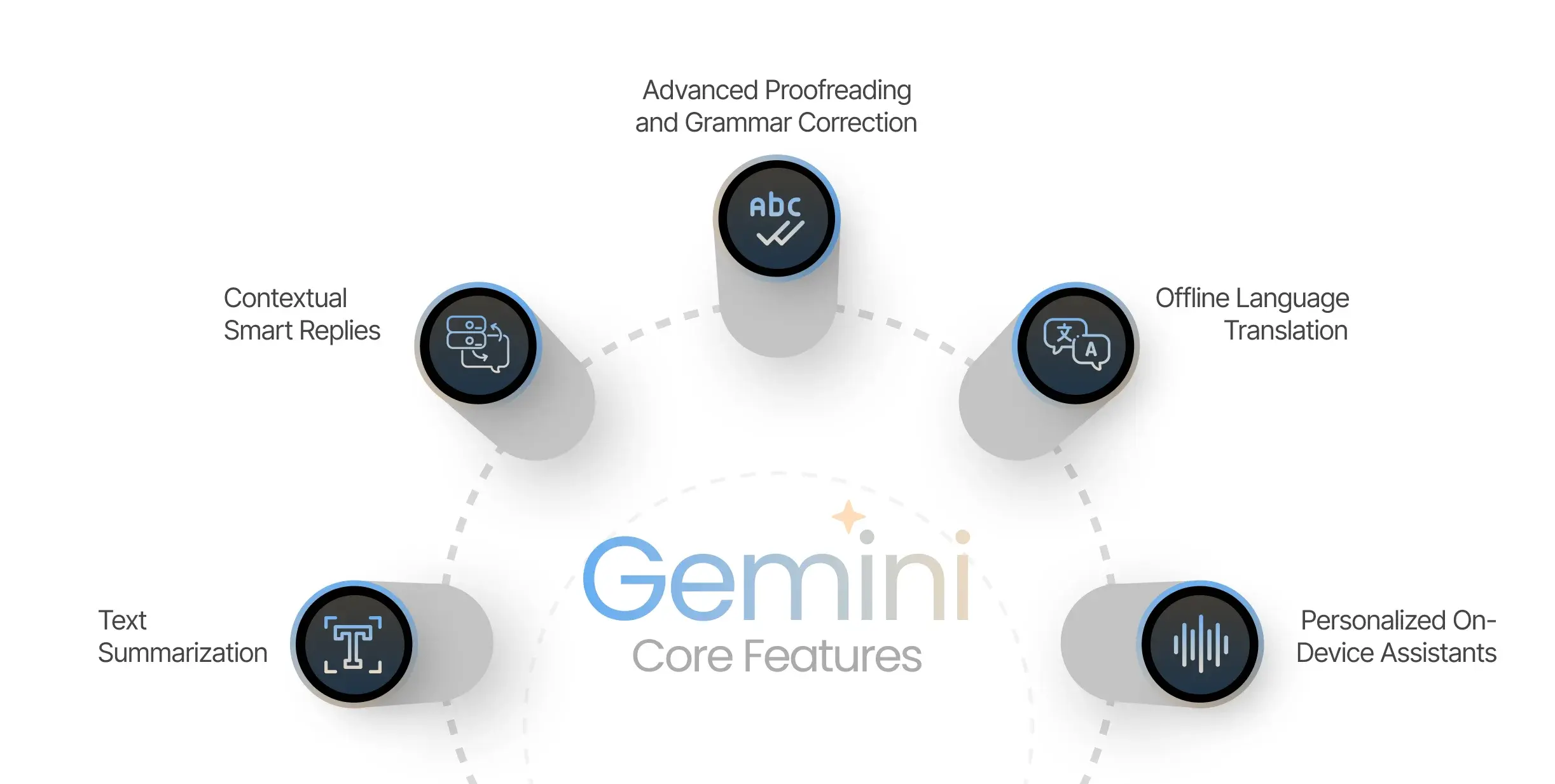
Technically, Gemini Nano comes in two parameter sizes (Nano-1 at ~1.8 billion and Nano-2 at ~3.25 billion) and is integrated into Android via Android AICore, a system service that manages hardware acceleration and seamless updates. This deep integration is what allows it to leverage specialized hardware efficiently.
Its core capabilities are tailored for immediate, personal assistance:
- Text Tasks: Summarizing web pages or documents, proofreading writing, and generating smart replies in messaging apps.
- Multimodal Tasks: Generating descriptions for images (image-to-text) and transcribing voice recordings with high accuracy.
- Product Integration: Powering features like automatic summaries in the Pixel Recorder app, real-time Call Notes, and context-aware suggestions in Gboard.
These integrations showcase the practical, everyday value of on-device AI.
The inherent properties of this approach are transformative: very low latency (no round-trip to a server), enhanced privacy as your data stays on-device, and full offline functionality. This makes advanced AI accessible anywhere, anytime. This is the foundation for the future of on-device ai in smartphones.
Cloud LLMs & The GPT-5 Benchmark
In the other corner are the cloud LLMs. These are the titans: models with tens to hundreds of billions of parameters, hosted in massive, energy-intensive data centers, requiring a constant network connection for use. For this comparison, we’ll use a hypothetical “GPT-5” as a stand-in for any frontier-scale cloud LLM, representing the absolute peak of raw computational power, reasoning depth, and breadth of knowledge.
The cloud model’s characteristics are defined by its scale: access to near-instantaneously updated world knowledge, integration with vast tool sets (web search, code interpreters), and the ability to tackle open-ended, complex reasoning tasks. However, this comes with inherent trade-offs: network latency (adding 100-400ms or more per request), ongoing API costs for developers and users, and privacy considerations as your prompts and data are processed on servers you don’t control.
This frames the fundamental dichotomy: Cloud LLMs dominate raw capacity and reasoning depth, while on-device LLMs dominate latency, privacy, and offline reliability for specific, personal tasks. The emergence of on-device AI like Gemini Nano creates a complementary, not replacement, paradigm.
The Hardware Engine: From Tensor G4 to Next-Gen Chips
Gemini Nano’s impressive performance isn’t magic; it’s unlocked by specialized hardware. Modern smartphone Systems on a Chip (SoCs) now include dedicated Neural Processing Units (NPUs) or Tensor Processing Units (TPUs)—processors designed from the ground up for the matrix multiplications that power AI.

The current state-of-the-art for Google’s devices is the Tensor G4 chip in the Pixel 9 series, which provides the necessary compute to power Gemini Nano for offline tasks. This hardware-software co-design is essential. Crucially, Android AICore acts as the conductor, efficiently scheduling compute tasks across the CPU, GPU, and NPU to minimize inference latency and power consumption. This system-level optimization is what makes the user experience feel instantaneous.
The relentless pace of silicon innovation is what sets the stage for the next leap in on-device capability, moving us into the realm of true performance analysis.
Pixel 10 Pro & Next-Gen Tensor Performance Analysis
To move beyond theory, let’s examine concrete, official benchmark data. Google’s own performance metrics for Gemini Nano on successive Pixel devices provide a clear picture of generational gains.
In August 2025, Google shared benchmarks showing a significant jump in “Prefix speed“—a measure of how quickly the model processes an initial input (text-to-text). On a Pixel 9 Pro, Gemini Nano processed approximately 510 tokens per second. On a Pixel 10 Pro running an improved model (nano-v2), this increased to about 610 tokens per second. Even more impressive, using a further optimized model (nano-v3) on the same Pixel 10 Pro hardware pushed performance to roughly 940 tokens per second. These figures underscore the rapid software and hardware co-evolution.

For multimodal tasks, the overhead is remarkably low. Adding an image-to-text task (like describing a photo) adds only about 0.6 to 0.8 seconds for the on-device image encoding process. This makes features like live captioning for videos or instant photo descriptions feel seamless.
What does this mean for you? Higher prefix speed translates directly to a snappier, more responsive UI. When you ask your phone to summarize an article, the text appears almost as you lift your finger. This performance is enabled by generational improvements in chip design: higher memory bandwidth, greater NPU throughput (measured in Tera-Operations Per Second, or TOPS), and more efficient architectures that allow for sustained performance without the device overheating and throttling.
Gemini Nano Speed & Efficiency Review
Let’s break down the gemini nano speed and efficiency review across key dimensions:
- Latency: This is on-device AI’s knockout punch. Responses occur in tens of milliseconds because there are zero network hops. Contrast this with a cloud LLM, where even under ideal conditions, you must add the time for your request to travel to a data center (often 50-150ms), wait in a server queue, be processed, and then travel back. This easily adds 100-400ms or more, a delay perceptible to humans. For real-time interaction, this difference is profound.
- Throughput: The official token-per-second numbers (approaching 1000 tokens/sec) are highly competitive for short, interactive bursts—perfect for the tasks Nano is designed for. However, for generating extremely long documents or analyzing massive datasets, cloud LLMs running on banks of accelerators will have a clear throughput advantage.
- Power & Thermal Constraints: This is the defining engineering