
Intel Lunar Lake Specs: The AI Revolution in Thin-and-Light Laptops
Estimated reading time: 12 minutes
Key Takeaways
- Intel Lunar Lake marks a pivotal release on September 24, 2024, revolutionizing AI-driven performance and efficiency in thin-and-light laptops.
- The architecture features a hybrid design with 4 Lion Cove P-cores and 4 Skymont E-cores, optimized for balanced power in mobile workloads.
- On-package LPDDR5X-8533 memory cuts power consumption by 40% and enables slimmer laptop designs.
- Integrated Xe2-based Arc graphics provide strong performance for casual gaming and creative tasks.
- The AI NPU laptop chip delivers up to 48 TOPS, enabling local AI processing for tasks like video call enhancements and generative AI.
- Lunar Lake powers Windows Copilot optimization for faster, privacy-focused AI assistance directly on-device.
- New CPU performance metrics like UL Procyon AI are essential for evaluating AI workload efficiency.
- With TDPs ranging from 17-37W, Lunar Lake enables fanless designs and exceptional battery life for portable computing.
Table of contents
- Intel Lunar Lake Specs: The AI Revolution in Thin-and-Light Laptops
- Key Takeaways
- Introduction: The Dawn of AI-Powered Portables
- Architecture Deconstructed: Hybrid Cores and On-Package Memory
- Processor Lineup: A Comprehensive Breakdown
- Integrated Graphics: Xe2 Arc for Everyday Performance
- AI NPU Chip: The Brain Behind Local Intelligence
- Windows Copilot Optimization: Seamless AI Assistance
- New CPU Performance Metrics: Beyond Traditional Benchmarks
- Recap and Future Outlook
- Frequently Asked Questions
Introduction: The Dawn of AI-Powered Portables
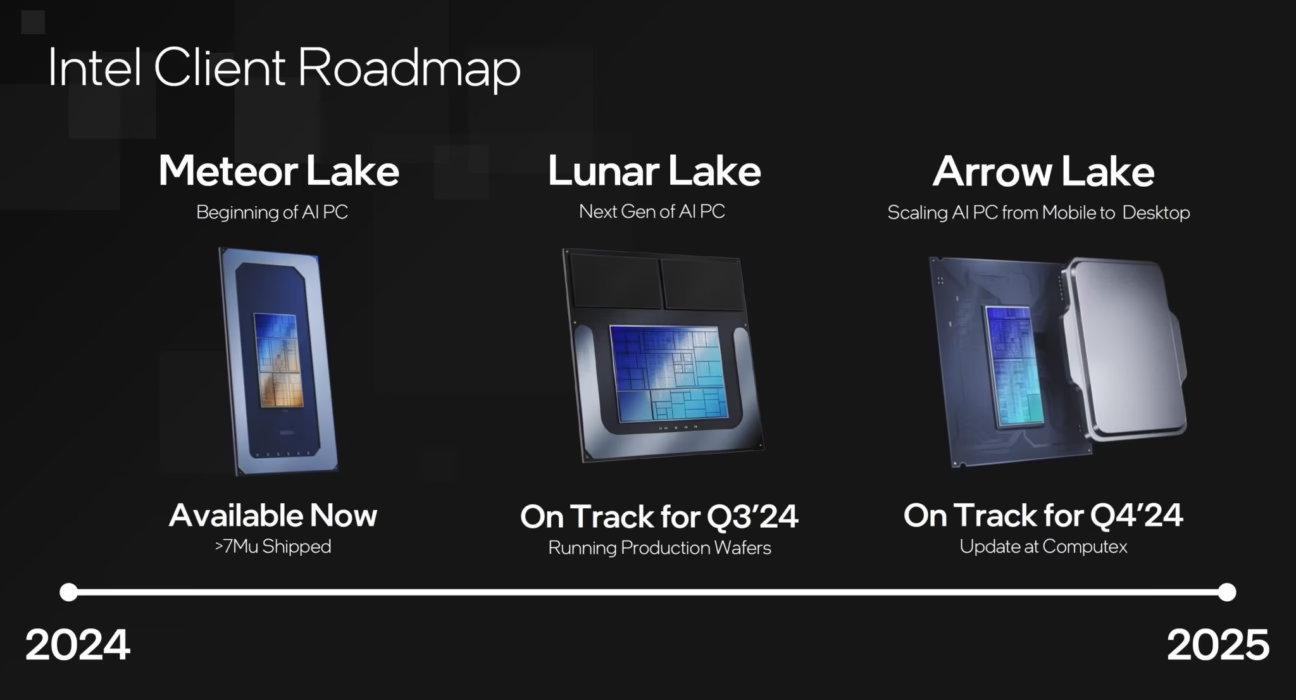
The excitement of next-generation laptop processors is here, revolutionizing thin-and-light computing with Intel Lunar Lake specs marking a pivotal release on September 24, 2024, for AI-driven performance and efficiency. Intel’s Lunar Lake, part of the Core Ultra 200V Series, represents a major advancement in mobile processors, prioritizing AI capabilities, power efficiency, and responsive user experiences for tech-savvy users tracking processor evolution.

This post aims to provide a comprehensive breakdown of Intel Lunar Lake specs, the AI NPU laptop chip, Windows Copilot optimization, and new CPU performance metrics to help you understand the real-world implications for your next laptop. Get ready to dive into an architecture built for the future, with a hybrid design, powerful NPU, and benchmark insights that promise significant performance gains in everyday AI tasks.
Architecture Deconstructed: Hybrid Cores and On-Package Memory
At its core, Lunar Lake uses a hybrid design with 4 Lion Cove P-cores (performance-oriented, no hyper-threading) and 4 Skymont E-cores (efficiency-focused) across all SKUs for balanced power in mobile workloads. The Lion Cove P-cores deliver high single-threaded speed, while Skymont E-cores optimize multi-threaded efficiency without hyper-threading, reducing complexity and power draw.

A standout feature in the Intel Lunar Lake specs is the on-package LPDDR5X-8533 memory, available in 16GB or 32GB options. This innovation cuts power consumption by 40% and shrinks the processor footprint by up to 250 mm² versus traditional soldered DRAM setups, enabling slimmer laptops with better thermals.
Processor Lineup: A Comprehensive Breakdown
Here’s a detailed look at the Intel Lunar Lake specs across the Core Ultra 200V Series:
| Branding | SKU | P-cores (threads) | E-cores (threads) | P-core Base/Turbo GHz | E-core Base/Turbo GHz | Arc Graphics (Xe-cores/Max Freq) | NPU TOPS | Smart Cache | Memory | Base TDP | Turbo/cTDP |
|---|---|---|---|---|---|---|---|---|---|---|---|
| Core Ultra 9 288V | 288V | 4/4 | 4/4 | 3.3/5.1 | 3.7/3.7 | 8 / 2.05 GHz | 48 | 12MB | 32GB | 17-30W | Up to 37W / 17-37W |
| Core Ultra 7 268V | 268V | 4/4 | 4/4 | 3.0/4.8 | 3.5/3.5 | 8 / 2.0 GHz | 48 | 12MB | 32GB | 17-30W | Up to 37W / 17-37W |
| Core Ultra 7 258V | 258V | 4/4 | 4/4 | 2.8/4.6 | 3.3/3.3 | 7 / 1.85 GHz | 47 | 10MB | 16GB | 17-30W | Up to 37W / 17-37W |
| Core Ultra 5 238V | 238V | 4/4 | 4/4 | 2.5/4.3 | 3.0/3.0 | 7 / 1.85 GHz | 40 | 8MB | 16GB | 17-30W | Up to 37W / 17-37W |

Note: Specifications are subject to change; refer to official Intel documentation for the latest details.
Integrated Graphics: Xe2 Arc for Everyday Performance
Lunar Lake integrates Xe2-based Arc graphics with up to 8 Xe-cores at 2.05 GHz, providing strong performance for casual gaming (e.g., 1080p titles) and creative tasks like video editing, outperforming prior generations in power efficiency. Lower-core variants like the Ultra 5 have 7 Xe-cores at 1.85 GHz, still offering capable integrated graphics for everyday use.

As highlighted in reports, this graphics architecture sets the stage for future advancements, with Panther Lake promising even greater gains.
Another key aspect of Intel Lunar Lake specs is the low TDP range of 17-37W, enabling fanless designs or ultra-thin laptops with exceptional sustained battery life. This positions Lunar Lake as the ideal choice for always-on portability, where efficiency meets performance.
AI NPU Chip: The Brain Behind Local Intelligence
The AI NPU laptop chip is a specialized hardware accelerator for AI inference tasks like matrix multiplications, performed on-device to minimize latency, reduce cloud reliance, and save battery. This on-device processing is crucial for responsive AI experiences.
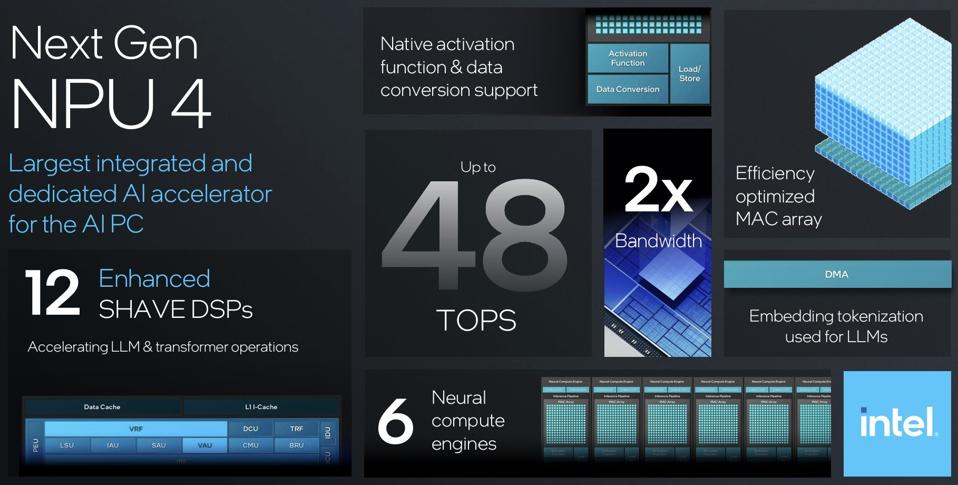
Lunar Lake’s NPU 4 delivers up to 48 TOPS from the NPU alone (e.g., 48 on Ultra 9/7 268V, 47 on 258V, 40 on Ultra 5), contributing to a total platform INT8 TOPS of 120 TOPS (NPU 48 + GPU 67 + CPU 5). This represents a massive leap over previous generations for local AI processing, as detailed in the AI NPU laptop chip specifications.
Enabled tasks include:
- Real-time background blur in video calls
- Active noise cancellation during meetings
- Automatic photo enhancements (e.g., object removal)
- Generative AI previews like text-to-image, all running locally without internet or high power drain
This integration of NPU capabilities is a cornerstone of Intel Lunar Lake specs, ensuring that AI-driven features are both efficient and accessible.
Windows Copilot Optimization: Seamless AI Assistance
Lunar Lake’s AI NPU laptop chip powers Windows Copilot optimization by executing complex AI models locally for Windows Copilot, resulting in faster response times on queries like document summarization, code generation, or image creation.

The benefits are clear:
- Quicker Copilot interactions: Near-instant replies versus cloud delays
- Handling more complex local queries: Advanced AI tasks without relying on internet connectivity
- Superior privacy: Data stays on-device without cloud transmission, supporting multi-modal AI involving voice, text, and visuals
Imagine a professional using Copilot on a Lunar Lake laptop for seamless all-day assistance—e.g., real-time meeting notes, slide generation, or voice-to-text—with minimal battery impact in thin-and-light form factors. This Windows Copilot optimization redefines productivity on the go.
New CPU Performance Metrics: Beyond Traditional Benchmarks
While traditional benchmarks like Cinebench (multi-threaded CPU) and Geekbench (single/multi-core) gauge raw power, new CPU performance metrics such as UL Procyon AI and Crossmark AI are essential for AI workloads, measuring inference speed, efficiency, and real-world task completion.
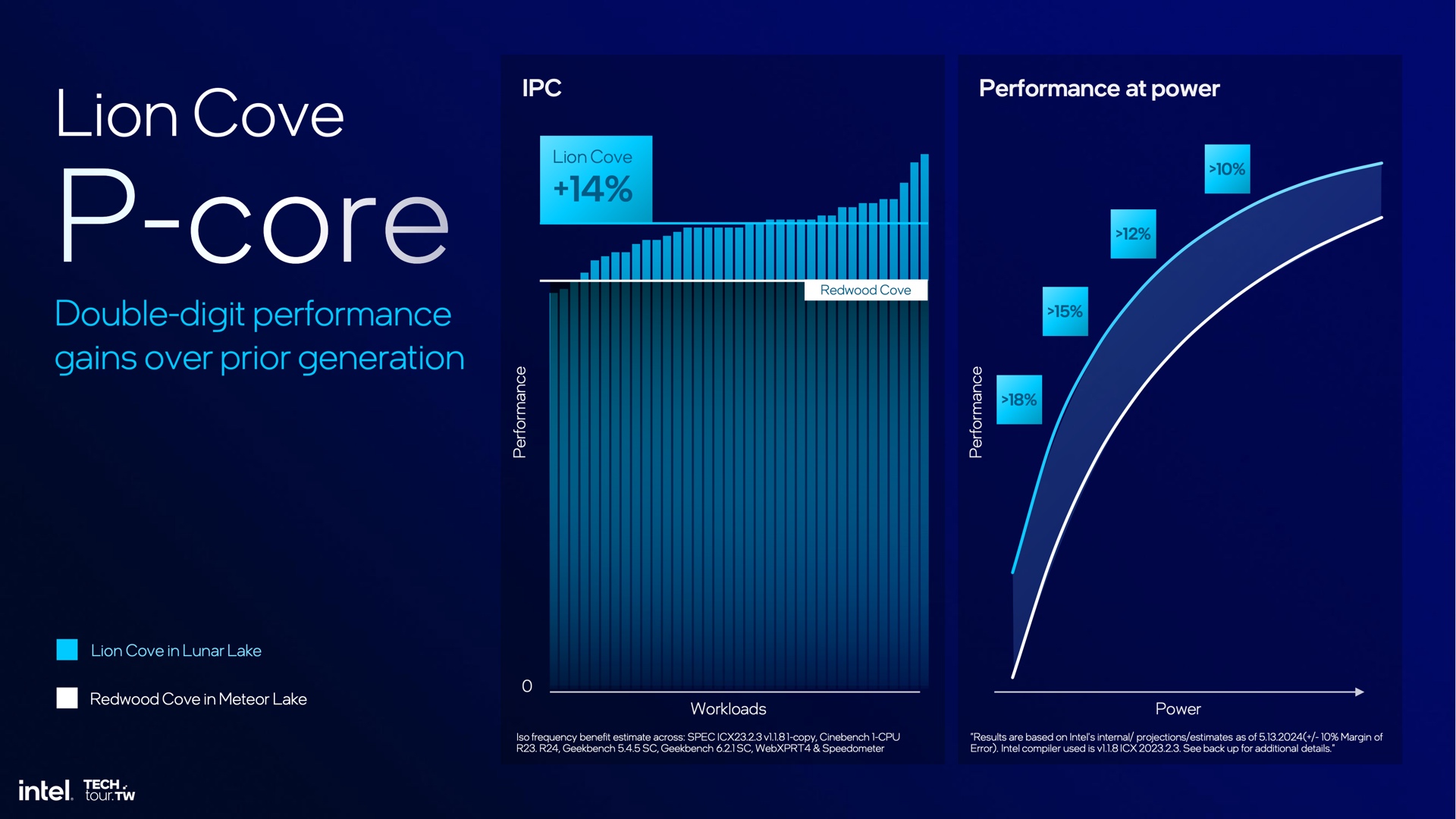
Here’s how to interpret these metrics:
- Aim for 40+ TOPS NPU for responsive local AI—Lunar Lake’s 48 TOPS scores highly in this regard.
- Use Intel’s performance index for context on workload-specific scores like AI inference latency.
When comparing positioning, Lunar Lake’s 120 TOPS platform excels in low-power AI versus prior Intel generations and rivals like AMD Zen 5. Note that Panther Lake (Core Ultra Series 3) claims 60% higher multi-threaded Cinebench at 25W and 77% better gaming (geomean of 45 titles at 1080p medium) over Ultra 9 288V due to more cores (up to 16) and Xe3 graphics (up to 12 cores), but Lunar Lake prioritizes efficiency in 17-37W scenarios, as seen in industry reports and Intel’s announcements.
Recap and Future Outlook
To recap the key Intel Lunar Lake specs: 4 Lion Cove P-cores + 4 Skymont E-cores, Xe2 Arc graphics up to 8 cores/2.05 GHz, on-package LPDDR5X memory, and a 48 TOPS AI NPU laptop chip for efficient, AI-ready thin laptops.
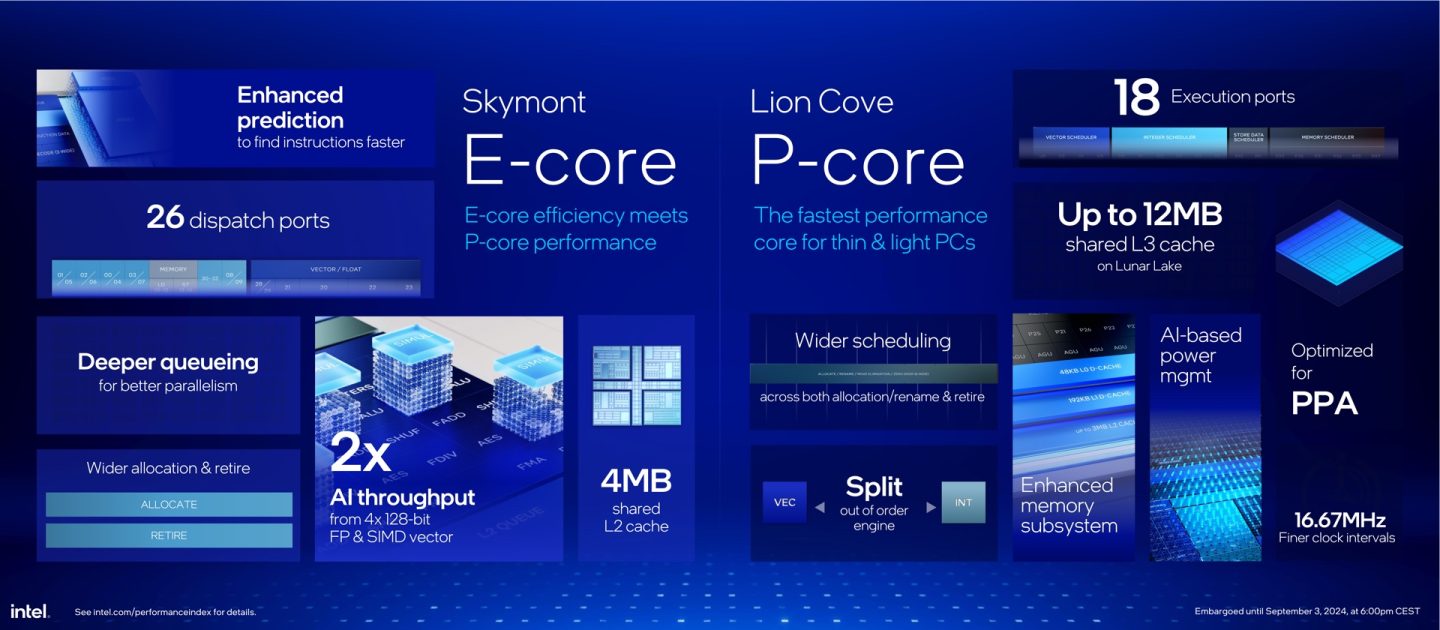
The impacts are clear: new CPU performance metrics reveal Lunar Lake’s edge in AI inference efficiency, amplified by Windows Copilot optimization for privacy-focused, responsive computing that outpaces predecessors. As noted in comparisons and emerging trends, this processor sets the benchmark for AI-powered portables.
Final thought: When shopping for your next laptop, prioritize these specs for future-proof performance. Check out Lunar Lake-equipped devices and consider how they align with your needs for AI-driven efficiency and portability.
Frequently Asked Questions
What is Intel Lunar Lake?
Intel Lunar Lake is the next-generation mobile processor series (Core Ultra 200V) focused on AI capabilities, power efficiency, and performance for thin-and-light laptops, launching on September 24, 2024.
How does the AI NPU benefit users?
The AI NPU (Neural Processing Unit) enables local AI processing for tasks like video call enhancements, noise cancellation, and generative AI, reducing latency, saving battery, and improving privacy by keeping data on-device.
What is the significance of on-package memory?
On-package LPDDR5X memory reduces power consumption by 40% and allows for slimmer laptop designs by integrating memory directly with the processor, improving thermals and efficiency.
How does Lunar Lake optimize Windows Copilot?
By leveraging the high-TOPS NPU, Lunar Lake executes AI models locally for Windows Copilot, resulting in faster responses, complex query handling, and enhanced privacy without cloud dependency.
What are the key performance metrics for AI workloads?
Beyond traditional benchmarks, metrics like NPU TOPS (e.g., 48 TOPS for Lunar Lake) and AI-specific benchmarks such as UL Procyon AI are crucial for evaluating AI inference speed and efficiency.