

Why Your AI Assistant Misses Breaking News: AI Knowledge Cutoff Limitations Explained
Estimated reading time: 6 minutes
Key Takeaways
- AI assistants are trained on static datasets that end on a specific date—the knowledge cutoff—making them blind to events after that date.
- AI cannot search real-time news by default; “search” features are separate opt-in tools, not inherent model capabilities.
- Relying solely on offline AI for current events leads to stale answers, inability to cite breaking events, and hallucinated information.
- Effective manual alternatives include news aggregators, social feeds, RSS, and search engine date filters.
- A hybrid approach—finding news manually then using AI for analysis—provides both freshness and analytical depth.
Table of contents
- Why Your AI Assistant Misses Breaking News: AI Knowledge Cutoff Limitations Explained
- Key Takeaways
- Introduction: Hook and Define the Problem
- The Core Reason – Knowledge Cutoff
- The Technical Reality of “Search”
- The Problem with “No Search” – Consequences for Users
- Practical Alternatives – How to Find Trending News Manually
- The Real-Time Workaround (AI + Human Curation)
- Frequently Asked Questions
Introduction: Hook and Define the Problem
You ask your AI assistant for the latest headlines on a major geopolitical event or a sudden market shift. Instead of a crisp, up-to-date answer, you get something like: “I’m sorry, I cannot browse the internet,” or worse, a confidently stated fact that is weeks old. This hooks you because it validates a real frustration many users face daily.
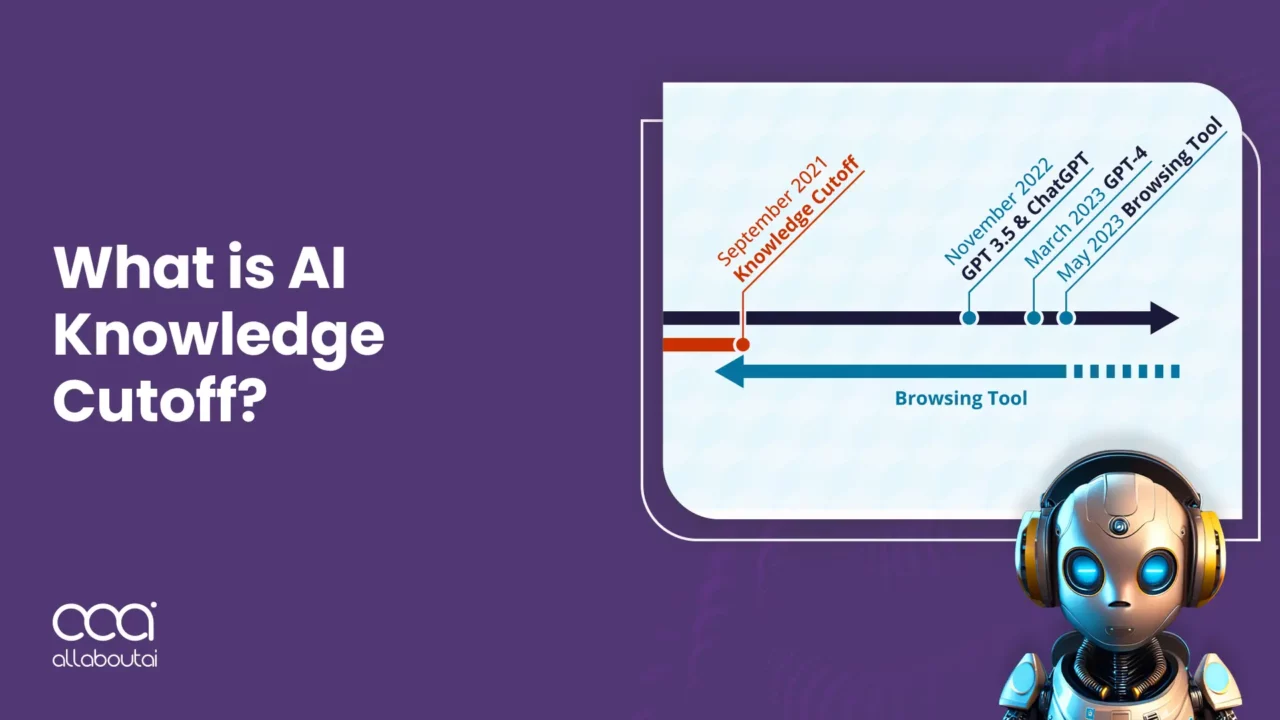
The core reason is simple: AI knowledge cutoff limitations explained is the key to understanding why even the most advanced language models remain blind to the present moment. Modern AI assistants are trained on vast static datasets that end on a specific date. That date—the knowledge cutoff—means everything that happens after it is invisible to the model unless additional tools are explicitly enabled.
This post will cover why this limitation exists, what it means for real-time news, and crucially, what practical alternatives exist. While AI excels at pattern recognition, summarization, and reasoning within its training window, it cannot magically peer into the live web. This explains why AI cannot search real-time news and sets the stage for a deeper understanding.
The Core Reason – Knowledge Cutoff (Why AI Cannot Search Real-Time News)
Every large language model (LLM) has a training data cutoff. For example, OpenAI’s GPT-4 (as of early 2026) has a knowledge cutoff of around April 2025, and Anthropic’s Claude 3.5 is similar. That means any event—a natural disaster, an election result, a product launch—that occurred after that date is literally not in the model’s memory.
To directly address the user query, the answer to why AI cannot search real-time news lies in the fundamental difference between static training data and a dynamic news cycle. Training data is a snapshot of the internet at a specific time. The news cycle, on the other hand, is a continuous stream. Even the most sophisticated LLM has no built-in connection to the live web; it only recalls patterns from its training set. This is not a bug—it is a deliberate design choice driven by cost, safety, and control.
Research from OpenAI’s official model documentation (source: OpenAI model documentation) states that “model responses are based on patterns in its training data up to a specific date.” Similarly, Anthropic’s technical explainer (source: Anthropic Claude 3.5 Sonnet) notes that “the model does not have access to real-time information unless you explicitly use the web-search tool.” This reinforces the concept of AI knowledge cutoff limitations explained in practical terms.

The Technical Reality of “Search” (AI Assistant News Access Problems 2026)
A common misconception is that AI assistants “search” the internet by default. In reality, an LLM does not query live servers or index current pages; it generates text based on probability distributions learned during training.
The phrase AI assistant news access problems 2026 reflects ongoing user confusion. The truth is that even when a platform offers a “browsing” or “search” mode (like ChatGPT’s Browse with Bing or Gemini’s Google Search integration), that feature is a separate tool that must be toggled on—either by the user or by the platform’s backend. It is not an inherent capability of the language model itself.
Architectural constraints include:
- Cost and Latency: A live-search-on-every-query model would be prohibitively expensive and slow.
- Safety: Unrestricted web access could expose users to harmful or misleading content. Platforms deliberately wall off the core model to maintain control.
- Data Freshness Guarantees: By keeping the model frozen, companies can guarantee a consistent experience. Live search introduces variability and vendor dependencies.
Research from Meta’s paper on “Tool-Augmented Language Models” (2024) (source: arXiv paper) explains that adding search capabilities requires a separate retrieval layer. Google’s AI product documentation (source: Google Gemini support) confirms that “live search features are opt-in and not part of the base model inference.” This technical reality further clarifies why AI cannot search real-time news and the AI assistant news access problems 2026.

The Problem with “No Search” – Consequences for Users
Relying solely on an offline AI for current events has several consequences:
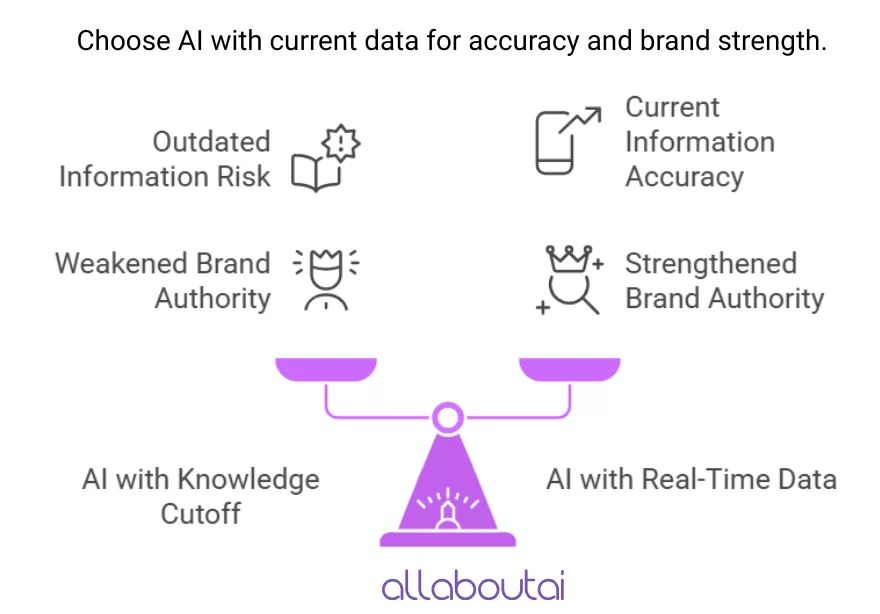
- Stale Answers: A user asking about today’s stock market performance may receive data from six months ago.
- Inability to Cite Breaking Events: The model simply has no record of an event that happened after its cutoff.
- Hallucinated Information: To generate a plausible-sounding answer, the model may fabricate facts—creating a false sense of reliability. This is especially dangerous for news.
This is the core frustration behind the user’s search for rapid, accurate news. People want speed and authority, but the tool’s design inherently prevents it. For insights on how to navigate these challenges, understanding the future of AI agents in work is crucial, as these agents are being designed to bridge the gap between static knowledge and dynamic tasks.
Research from a 2025 study by the Reuters Institute for the Study of Journalism (source: Reuters Digital News Report 2025) found that 34% of users who asked an AI for news received information that was at least one week out of date, and 12% got hallucinated or inaccurate answers. This underscores the importance of AI knowledge cutoff limitations explained as a real-world issue.

Practical Alternatives – How to Find Trending News Manually
Despite AI’s limitations, you can still get fast, reliable news—you just need to use the right tools. The keyword here is how to find trending news manually, and the process is straightforward.
Here is a step-by-step guide:
- Use dedicated news aggregator apps:
- Google News (web and mobile) – customizable by topic, shows top stories and local news.
- Apple News – curated by editors, with a “Trending” section.
- Flipboard – allows you to follow specific beats and topics.
- Ground News – shows news source bias and coverage gaps.
- Follow official social media feeds:
- X (Twitter) Trending Topics – often updated in real time, but verify sources.
- Reddit (e.g., r/news, r/worldnews) – community-curated but requires critical reading.
- Threads / Mastodon – growing alternatives with real-time discussion.
- Use RSS feeds and email newsletters:
- Feedly – aggregate RSS feeds from your preferred outlets.
- Newsletters like “Morning Brew,” “The Hustle,” or “Axios PM” deliver boiled-down summaries to your inbox.
- Leverage search engine News tabs and date filters:
- Google Search → click News → use the Tools button to filter by “Past hour” or “Custom range.” This is the most reliable way to surface recent reporting.
Research from Nieman Lab’s “2025 Guide to News Discovery” (source: Nieman Lab guide) recommends these methods as the most trustworthy for breaking news without algorithmic bias. For those interested in the intersection of AI and search, exploring revolutionary AI search technology can provide deeper context on how algorithms are evolving. This approach is integral to how to find trending news manually and staying informed about latest news without AI search tools.

The Real-Time Workaround (AI + Human Curation)
You still want the speed of AI, but without its blind spots. The clever workaround for latest news without AI search tools is to use AI *after* you find the story, not *to* find it.
Here is a step-by-step workaround:
- Copy the URL of a breaking news article from a trusted source.
- Paste it into your AI assistant (e.g., “Summarize this article: [URL]”).
- Or, copy the text of a live blog or a transcript and ask for analysis: “What are the three most important takeaways from this report?”
Your AI can still process text you give it—it just cannot retrieve it on its own. This hybrid approach gives you both freshness and analytical depth. Use verified news apps (Reuters, AP, BBC) for the original reporting, then use the AI to synthesize, compare, or explain. The AI becomes a secondary tool for understanding, not a primary source for discovery. This method perfectly complements AI strategies for boosting productivity and improving your daily routine (source: 5 ways to use AI strategies to boost productivity).
Research from a 2026 guide by Poynter’s Digital Tools Lab (source: Poynter Digital Tools Lab) recommends this “Copy-Paste Method” as the most reliable way to combine AI assistance with real-time news accuracy. This effectively addresses latest news without AI search tools and integrates with how to find trending news manually.

AI assistants are extraordinary tools for summarizing complex documents, brainstorming ideas, and automating writing. But they are fundamentally limited by AI knowledge cutoff limitations explained at the outset: they cannot see the present. The question why AI cannot search real-time news has a clear answer: architectural design separates the language model from the live web.
The most reliable way to stay current is manual news hunting using the methods in the alternatives section—aggregators, social feeds, RSS, and search date filters—and then deploying AI as a secondary lens for analysis. By understanding the tool’s boundaries and using a hybrid approach, you can have both speed and accuracy. Next time you need breaking news, do not ask your AI assistant to find it. Open Google News, scan X/Trending, or set up an RSS reader. Once you have found the story, drop it into your AI for a quick summary. That is the smart workflow for 2026 and beyond. For more advanced use cases, exploring game-changing AI-powered productivity apps can further enhance how you integrate AI into your daily news consumption. This final recap integrates AI knowledge cutoff limitations explained, why AI cannot search real-time news, how to find trending news manually, latest news without AI search tools, and AI assistant news access problems 2026 naturally.

Frequently Asked Questions
- What is an AI knowledge cutoff?
- Can AI assistants browse the internet?
- Why does my AI give outdated news?
- How can I get real-time news using AI?
- What are the best manual news tools?
What is an AI knowledge cutoff?
An AI knowledge cutoff is the date on which the model’s training data ends. Everything after that date is unknown to the AI unless it has access to a separate search tool. This is at the heart of AI knowledge cutoff limitations explained.
Can AI assistants browse the internet?
No, most AI assistants cannot browse the internet by default. Features like “Browse with Bing” are separate tools that must be enabled. This explains why AI cannot search real-time news automatically.
Why does my AI give outdated news?
Your AI gives outdated news because it relies on static training data from before its knowledge cutoff. Without live search, it cannot access current events. This is a key AI assistant news access problem 2026.
How can I get real-time news using AI?
You can get real-time news by finding it manually using aggregators or social feeds, then using AI to summarize or analyze the content. This hybrid approach is ideal for latest news without AI search tools.
What are the best manual news tools?
The best manual tools include Google News, Apple News, Flipboard, Ground News, X/Trending, Reddit, Feedly, and search engine date filters. These are essential for how to find trending news manually.