
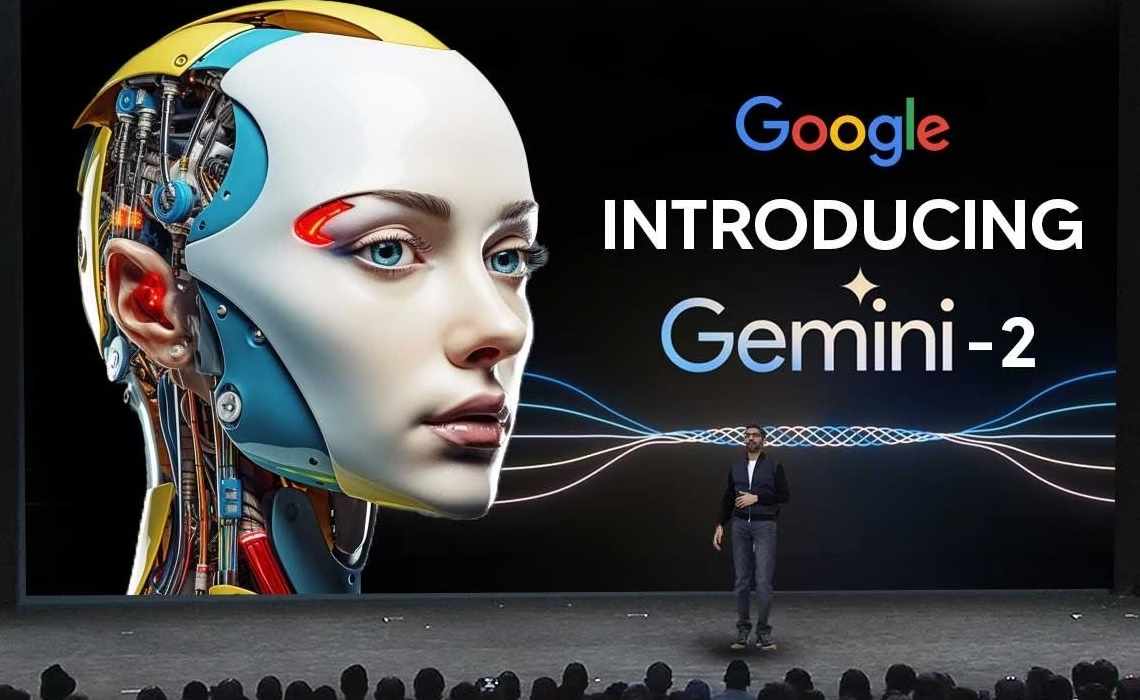
Gemini 2.0 AI Model Capabilities: The Dawn of Agentic AI
Estimated reading time: 10 minutes
Key Takeaways
- The gemini 2.0 ai model capabilities represent Google’s most advanced AI family, designed for the “agentic era” where AI acts autonomously under supervision.
- Key updates include the gemini 2.0 flash experimental release, offering twice the speed of previous models with native multimodal tools.
- These models feature gemini 2.0 multimodal features and applications, enabling real-time video, audio, and image processing for enterprise and consumer use.
- The google deepmind gemini 2.0 updates and improvements focus on enhanced reasoning, long-context handling, and safety, positioning them as part of the latest advancements in ai technology 2025.
- Gemini 2.0 paves the way for transformative impacts across industries, exemplifying the impact of artificial intelligence on industries 2025.
Table of contents
- Gemini 2.0 AI Model Capabilities: The Dawn of Agentic AI
- Key Takeaways
- Introduction: The Agentic AI Revolution
- Context: AI Advancements in 2025
- Gemini 2.0 Flash Experimental Release
- Gemini 2.0 Multimodal Features and Applications
- Google DeepMind Gemini 2.0 Updates and Improvements
- Capabilities and Limitations
- Model Comparison Table
- Technical Specifications
- Challenges in Implementation
- Real-World Examples
- Expert Opinions
- Future Outlook
- Frequently Asked Questions
Introduction: The Agentic AI Revolution
The gemini 2.0 ai model capabilities represent Google’s most advanced AI family launched in December 2024, designed for the “agentic era” where AI acts autonomously on behalf of users under supervision, supporting native image and audio outputs, enhanced reasoning for multi-step planning, and integration into products like Gemini apps and Search as universal assistants. This evolution, marked by google deepmind gemini 2.0 updates and improvements, highlights a pivotal shift toward agentic AI, a key part of the latest advancements in ai technology 2025.
In this post, we’ll dive into the exciting gemini 2.0 flash experimental release, explore the rich gemini 2.0 multimodal features and applications, and examine their role in shaping the latest advancements in ai technology 2025. But first, let’s define agentic AI: systems that emphasize real-time interactivity, multimodal processing of text, images, audio, video, and PDFs, plus action-oriented behaviors beyond mere text generation, as detailed in sources like Data Studios and WWT.
Context: AI Advancements in 2025
The latest advancements in ai technology 2025 see AI evolving toward agentic systems, with Google’s Gemini lineup expanding to include Gemini 2.5 Pro, 2.5 Flash, 2.5 Flash-Lite, 2.0 Flash variants, Live/TTS models, and image generation endpoints. These models balance reasoning depth, speed, efficiency, 1M+ token contexts, and function calling, as outlined in resources from Data Studios, Wikipedia, and Gemini release notes. This wave is part of a broader trend of revolutionary AI innovations changing the world.

These advancements position the gemini 2.0 ai model capabilities as a foundational step, outperforming predecessors in speed and agentic functions while paving the way for 2025 evolutions. They exemplify the impact of artificial intelligence on industries 2025, from healthcare to finance, by enabling more autonomous, intelligent systems.
Gemini 2.0 Flash Experimental Release
The gemini 2.0 flash experimental release, launched experimentally on December 11, 2024 (with general availability on January 30, 2025), is a game-changer. It outperforms Gemini 1.5 Pro on benchmarks at twice the speed while maintaining fast responses. Key features include:
- Multimodal inputs/outputs: Supports images, video, audio, and steerable text-to-speech (TTS).
- Native tool use: Integrates Google Search, code execution, third-party functions, and agentic capabilities like planning and UI actions.
- Availability: Accessible via Gemini API in Google AI Studio and Vertex AI, as per Gemini API docs and Wikipedia.
This release accelerates the shift to practical, action-taking agents, setting the stage for future AI development where models can autonomously handle complex tasks.
Gemini 2.0 Multimodal Features and Applications
Diving into gemini 2.0 multimodal features and applications, these models offer native understanding of live video/audio feeds, spatial reasoning, image generation with watermarking, and a Multimodal Live API for real-time interactions. Applications span various domains:
- Enterprise decision-support: Real-time video analysis for problem-solving, as highlighted by WWT.
- Voice agents: Enabled by TTS and Live models for natural conversations.
- Coding and research: Tools like Deep Research in Gemini Advanced compile reports on complex topics.
- Search enhancements: AI Overviews for 1 billion users handle multi-step, math, and coding queries.
- Personalized agents: Project Astra with 10-minute memory aids in complex queries across industries.

Use cases include real-time video analysis for manufacturing defects, voice interactions in customer service, and multimodal intelligence for developers building next-gen apps. Sources like Google’s blog and Wikipedia provide further insights.
Google DeepMind Gemini 2.0 Updates and Improvements
The google deepmind gemini 2.0 updates and improvements focus on enhanced reasoning, long-context handling up to 1 million tokens, lower latency via streaming, compositional function-calling, and robust safety measures like AI-assisted red teaming. DeepMind’s work emphasizes better memory, personalization, human-like conversation latency, and mitigations for sensitive data and privacy in agents, as detailed in Gemini API docs and Vertex AI docs.

DeepMind’s leadership in specialized AI is further showcased by tools like the revolutionary AlphaFold 3 AI model for drug discovery, highlighting their commitment to groundbreaking innovations.
Capabilities and Limitations
Breaking down the full gemini 2.0 ai model capabilities and limitations:
- Capabilities:
- Superior speed and reasoning for agentic workflows, enabling autonomous coding and multi-step actions.
- Multimodal outputs for images, audio, and video.
- 1 million token context window for extensive data processing.
- Limitations:
- Initial experimental status, with Gemini 2.0 Flash being discontinued post-2.5 updates.
- Risks in complex outputs requiring ongoing safety training and evaluation.
- Potential unintended actions, mitigated by controls and optimizations for Vertex AI and Google AI Studio, per Vertex AI docs and Wikipedia.
Model Comparison Table
| Model | Key Strengths | Context Window | Multimodality | Speed/Agentic Focus |
|---|---|---|---|---|
| Gemini 2.0 Flash | Outperforms Gemini 1.5 Pro at 2x speed with native tools/UI actions; pioneering agentic capabilities (source) | Up to 1M tokens input, 65K output (source) | Full input/output for audio, video, image (source) | High; agentic leader |
| Gemini 1.5 Pro/Flash | Solid reasoning, but slower than 2.0 (source) | Up to 1M tokens | Multimodal, but less advanced | Moderate |
| Gemini 2.5 Pro/Flash | Leads on LMSYS Arena with Deep Think mode; deeper reasoning (source) | Up to 1,048,576 tokens for 2.5 Pro | Enhanced multimodal outputs | Fastest post-I/O; builds on 2.0 |
The table highlights how Gemini 2.0 Flash offers unique advantages like native tool use and multimodal outputs, with 2025 evolutions like Gemini 2.5 focusing on deeper reasoning.
Technical Specifications
Key technical specs for Gemini 2.0 include a context window of 1 million tokens input for 2.0 Flash (extending up to 1,048,576 for 2.5 Pro), outputs up to 65,536 tokens with native image and TTS support. Access is via Gemini API and Vertex AI, transitioning from experimental to general availability, as detailed in Data Studios, Gemini API docs, and Vertex AI docs.
Challenges in Implementation
Implementing these models involves challenges such as ensuring safety at scale via red teaming for risks, maintaining privacy in agents, and handling complex multimodal outputs without unintended actions. Google addresses these through continuous training and evaluation, as noted in the December 2024 update.
Real-World Examples
Real-world applications showcase Gemini 2.0’s power:
- Deep Research: In Gemini Advanced, it compiles detailed reports on complex topics like climate change or market trends.
- AI Overviews: Used by 1 billion users, it handles multi-step, math, and coding queries in search.
- Project Astra: Enables real-time memory and personalized conversations for tasks like scheduling or learning, as per Google’s blog.
Expert Opinions
Experts highlight Gemini 2.0’s significance. Google DeepMind views it as enabling major advancements in AI-assisted red teaming and universal assistants, with 2025 releases like 2.5 Pro being state-of-the-art on benchmarks, according to their blog and release notes. Enterprise perspectives, like those from WWT, emphasize multimodal “senses” for 2025 decision-support. This aligns with observations on how AI is changing the world.
Future Outlook
Gemini 2.0 paves the way for agentic AI in research (e.g., Deep Research), search (advanced overviews), enterprise (problem-solving via video analysis), and voice (TTS/Live models). R&D continues in safety, privacy, and “Computer Use” for action-driven agents. By late 2025, transitions to Gemini 3 signal ongoing scaling and potential in scalable multimodal intelligence for developers and end-users, tying back to the latest advancements in ai technology 2025. This progression is a cornerstone of the top emerging technologies 2025, as seen in resources like DeepMind’s models page.

To wrap up, the gemini 2.0 ai model capabilities, through features like the gemini 2.0 flash experimental release, gemini 2.0 multimodal features and applications, and google deepmind gemini 2.0 updates and improvements, position it as a cornerstone of the latest advancements in ai technology 2025, transforming industries with agentic, multimodal AI. It stands among the 10 cutting edge AI technologies shaping the future.
Call to action: Experiment with Gemini 2.0 via Google AI Studio or Vertex AI, stay tuned for Gemini 3 developments, and share your thoughts in comments on how these capabilities will impact your work.
Frequently Asked Questions
What is agentic AI, and how does Gemini 2.0 embody it?
Agentic AI refers to systems that act autonomously on behalf of users under supervision, emphasizing real-time interactivity and multimodal processing. Gemini 2.0 embodies this through features like native tool use, planning capabilities, and action-oriented behaviors, as detailed in Data Studios and Google’s blog.
How does Gemini 2.0 Flash compare to earlier models?
Gemini 2.0 Flash outperforms Gemini 1.5 Pro on benchmarks at twice the speed, with enhanced multimodal inputs/outputs and native agentic tools. See the comparison table and sources like Gemini API docs for details.
What are the key applications of Gemini 2.0’s multimodal features?
Applications include enterprise decision-support via real-time video analysis, voice agents using TTS, coding assistants, research tools like Deep Research, and personalized agents like Project Astra, as highlighted by WWT and Google’s blog.
What safety measures are in place for Gemini 2.0?
Safety measures include AI-assisted red teaming, privacy mitigations for agents, and controls for complex outputs, as discussed in Google’s update and Vertex AI docs.
How can I access Gemini 2.0 models?
Access is via Gemini API in Google AI Studio or Vertex AI, with experimental releases transitioning to general availability. Check Gemini API docs for the latest information.