


“`html
Keyword Research: The Foundation of SEO Success
Estimated reading time: 10 minutes
Key Takeaways
- Keyword research is the essential first step for any effective search engine optimization strategy, driving targeted traffic and business results.
- Understanding search intent – the ‘why’ behind a user’s query – is crucial for selecting keywords that resonate and convert.
- The keyword research process involves brainstorming, utilizing tools, exploring various keyword types (short-tail, long-tail, LSI), and analyzing metrics like search volume and competition.
- Strategic keyword targeting aligns chosen keywords with specific content types and the user’s journey, including the use of topic clusters.
- Practical techniques include analyzing competitor keywords, leveraging Google Search Console and Analytics, and exploring SERP features.
- Keywords should be integrated naturally into content, with a focus on user experience, and keyword stuffing must be avoided.
- Keyword research is an ongoing, iterative process vital for adapting to search landscape changes and maintaining SEO performance.
Table of contents
- Keyword Research: The Foundation of SEO Success
- Key Takeaways
- Introduction
- Section 1: Understanding Search Intent – The “Why” Behind the Words
- Section 2: The Keyword Research Process – From Seed to Strategy
- Section 3: Choosing the Right Keywords for Targeting – Strategic Selection
- Section 4: Practical Keyword Research Techniques – Tools and Tactics
- Section 5: Integrating Keywords into Your Content – On-Page Optimization
- Section 6: Ongoing Keyword Research and Optimization – A Continuous Cycle
- Conclusion
- Frequently Asked Questions
Introduction
Imagine trying to navigate a vast city without a map or a destination in mind. That’s akin to embarking on a digital marketing journey without understanding what your audience is actually looking for. This is precisely why keyword research is the bedrock of any successful search engine optimization strategy. It’s the compass that guides your efforts, ensuring you attract organic traffic, generate qualified leads, and ultimately, drive revenue in today’s search-first digital landscape.

So, what exactly is keyword research? It’s the strategic process of discovering and analyzing the specific words and phrases your target audience uses when they type queries into search engines. The ultimate goal is to gain a deep understanding of their needs and search intent, enabling you to create content that directly addresses those needs. Source.

Without robust keyword research, it becomes incredibly challenging to craft content that not only ranks well but also attracts the *right* kind of visitors – those who are genuinely interested in what you offer and are more likely to convert. This foundational work supports crucial business objectives, whether it’s increasing sign-ups, generating inquiries, or driving direct sales. Source, Source.
This guide is designed to demystify the process. We’ll provide a clear, step-by-step walkthrough on how to perform effective keyword research, how to evaluate potential opportunities, and, most importantly, how to translate these valuable insights into a practical, actionable content plan that aligns with your business goals.
Our primary focus throughout this guide will be the core keyword “keyword research”. However, to provide a truly comprehensive understanding, we will also delve into related SEO keywords such as keyword analysis, search intent, and the significance of long-tail keywords, ensuring you have all the knowledge needed to excel.
Section 1: Understanding Search Intent – The “Why” Behind the Words
Before diving into the “what” and “how” of keyword discovery, it’s essential to grasp the *why* – the underlying motivation behind a user’s search query. This is known as search intent. It’s the fundamental goal or motivation behind a user’s query when they type something into a search engine. Essentially, it’s what they are *truly* trying to achieve with their search. Source.

Why does intent matter so much for keyword research? Because targeting keywords that misalign with user intent is a recipe for disappointment. You might achieve high search volume for a keyword, but if your content doesn’t match what the user is actually looking for, you’ll end up with poor engagement rates, low conversion rates, and significant ranking difficulties. Search engines are increasingly sophisticated at understanding intent, and they prioritize content that best satisfies it.
To effectively align your content with user needs, it’s crucial to understand the different types of search intent:
-
Informational: These users are seeking answers, knowledge, or educational content. They want to learn something new.
*Example:* “what is keyword research”
-
Navigational: Users with this intent aim to find a specific website, brand, or online resource. They know where they want to go, but need a quick way to get there.
*Example:* “Google Search Console login”
-
Transactional: These users are ready to make a purchase or take a high-intent action. They are at the bottom of the sales funnel.
*Example:* “buy SEO software online”
-
Commercial Investigation: Users in this stage are in the research and comparison phase. They are evaluating options before a potential purchase.
*Example:* “best keyword research tools for beginners”
Aligning your chosen SEO keywords with the appropriate user intent requires a thoughtful approach. Here’s how to do it effectively:
- Analyze the SERPs: For any given query, look at the existing top-ranking content. What kind of pages are appearing? Are they blog posts, product pages, comparison articles, or forums? This is a strong indicator of what Google believes users want for that search term.
- Match Content to Intent: Once you’ve discerned the dominant user intent, select appropriate SEO keywords and create corresponding content formats that directly satisfy that intent. For informational intent, a comprehensive guide or blog post is suitable. For transactional intent, a product page or a service offering is more appropriate. Source, Source.
Section 2: The Keyword Research Process – From Seed to Strategy
Now that we understand the critical role of search intent, let’s walk through the systematic process of uncovering valuable keywords.
Step 1: Brainstorm Seed Topics
Begin by identifying broad, core topics that are directly relevant to your products, services, or the problems your target audience is trying to solve. Think about the main areas your business operates within.
*Example Seed Topics:* “keyword research,” “SEO tools,” “content strategy,” “digital marketing,” “website optimization.”
Source.

Step 2: Utilize Tools to Identify Keywords
Seed topics are just the starting point. To uncover a comprehensive list of relevant terms, you’ll need to leverage specialized tools. There’s a wide array of options available, catering to different budgets and needs:
* Free Options: These are excellent for getting started or for those on a tight budget.
- Google Keyword Planner (requires a Google Ads account)
- Google Trends (for understanding search interest over time)
- Google Suggest (autocomplete suggestions as you type in the search bar)
- Google Search Console (shows queries you’re already getting impressions for)
* Freemium Options: These offer a limited set of features for free, with paid plans unlocking more advanced capabilities.
- Keywords Everywhere (browser extension showing search volume and related keywords)
- Ubersuggest (keyword suggestions, content ideas, and SEO audits)
* Paid Options: These are powerful, all-in-one SEO platforms offering extensive data and analysis features.
- Ahrefs
- Semrush
- KWFinder (part of Mangools)
Step 3: Explore Different Keyword Types
Keywords aren’t monolithic; they come in various forms, each with its own characteristics and strategic value:
* Short-tail (head) keywords: These are typically one or two-word phrases. They are broad, attract high search volume, but are usually very competitive and can have ambiguous search intent.
*Example:* “SEO”
Source.
* Long-tail keywords: These are longer, more specific phrases, often comprising three or more words. They generally have lower search volume but indicate clearer user intent and typically have much lower competition, making them easier to rank for and more likely to convert.
*Example:* “how to do keyword research for a blog post”
Source, Source.
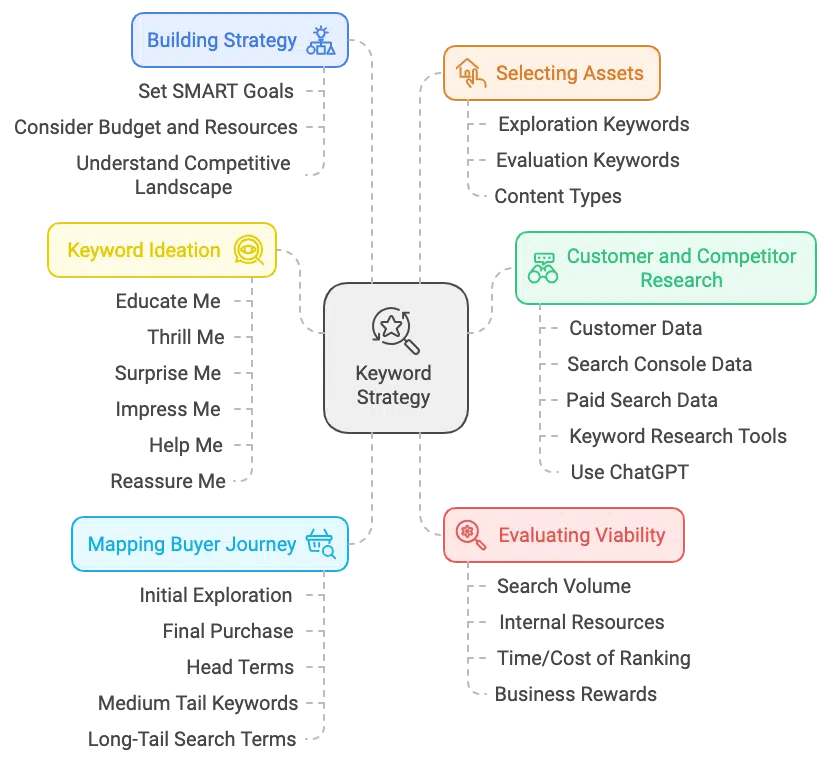
* LSI / semantically related keywords: These are terms and phrases that are contextually linked to your main topic. They help search engines understand the depth, relevance, and nuances of your content, signaling a more comprehensive understanding of the subject matter.
*Example:* “search intent,” “keyword difficulty,” “search volume,” “organic traffic.”
Source.
Step 4: Analyze Search Volume, Competition, and Relevance
Once you have a list of potential keywords, you need to evaluate them based on several key metrics:
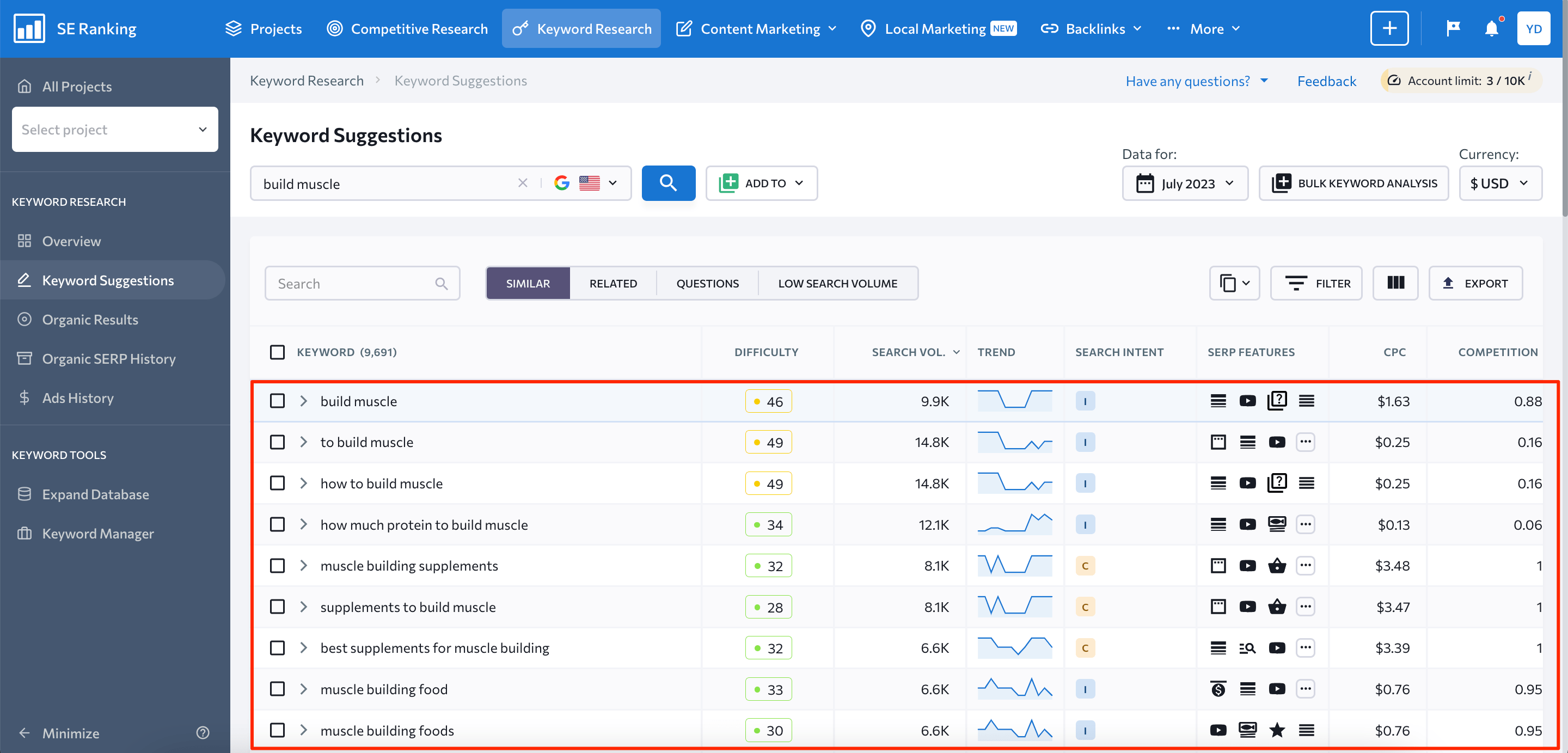
* Search volume: This refers to the average number of monthly searches a particular keyword receives. Higher search volume indicates greater potential reach, but often comes with higher competition.
Source.
* Keyword difficulty / competition: This metric, provided by most SEO tools, is an estimate of how challenging it will be to rank for a given keyword. It’s often calculated based on the authority, backlink profiles, and content quality of the pages currently ranking in the top positions.
Source, Source.
* Relevance: This is arguably the most crucial factor. How closely does the keyword align with your audience’s actual needs, the specific topic of your content, and your overall business goals? A keyword with high search volume and low difficulty is useless if it doesn’t attract the right kind of traffic that can lead to conversions.
Source.
Section 3: Choosing the Right Keywords for Targeting – Strategic Selection
The goal of keyword research isn’t just to find keywords, but to find the *right* keywords for your specific strategy. This involves a strategic balance between several factors.

Finding Relevant and Achievable Keywords
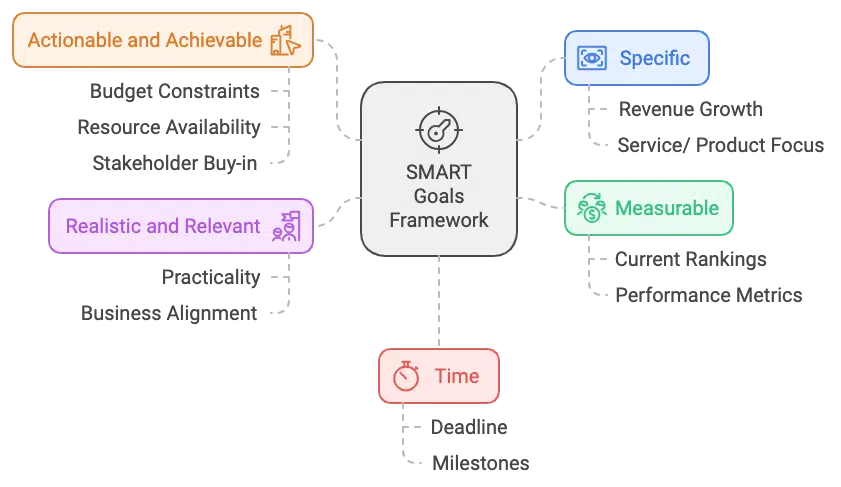
Look for a sweet spot where keywords have sufficient search volume to be worthwhile, a manageable keyword difficulty that aligns with your website’s authority, and a clear connection to potential commercial value. Prioritize terms where ranking is realistically achievable given your current domain authority and available resources. It’s better to rank well for a less competitive, more specific term than to struggle for visibility on a highly competitive, broad term. Source, Source.
Keyword Targeting by Content Type
The best keywords to target often depend on the type of content you are creating. Aligning your keyword strategy with your content format is key:
-
Blog posts: These are generally best suited for informational queries and early-stage commercial investigation keywords. Think about the questions your audience is asking as they begin to explore a topic.
*Example Keywords:* “how to do keyword research,” “checklist for keyword research,” “what is content marketing.”
-
Landing pages: These are designed for conversion. Therefore, target keywords that indicate a higher level of purchase intent, including transactional and late-stage commercial investigation terms.
*Example Keywords:* “hire SEO consulting services,” “expert keyword research service,” “affordable link building package.”
-
Product/feature pages: These pages should target highly specific, long-tail keywords that indicate a user is looking for exactly what you offer.
*Example Keywords:* “AI keyword research tool for agencies,” “WordPress plugin for schema markup,” “SaaS CRM for small business.”
Topic Clusters and Their Relation to Keyword Research
A powerful content strategy involves structuring your website around topic clusters. This approach not only helps users navigate your site but also signals to search engines that you have comprehensive authority on a subject.
* Define Topic Clusters: A topic cluster is a content strategy where a central “pillar page” covers a broad topic extensively, and multiple “cluster posts” (or sub-pages) delve into specific, related subtopics. These cluster posts then link back to the pillar page, creating a cohesive web of content.
* How Keyword Research Helps: Effective keyword research is fundamental to building successful topic clusters. It helps you identify:
- The primary pillar keyword: This is usually a broader, more competitive term that your pillar page will target (e.g., “keyword research”).
- Supporting long-tail and semantically related keywords: These are ideal for your cluster articles, covering specific aspects of the main topic (e.g., “how to analyze SEO keywords,” “best free keyword research tools,” “keyword mapping template,” “understanding search intent”).
This organized approach ensures you cover a topic thoroughly, catering to a wide range of user intents and keyword variations. Source, Source.
Section 4: Practical Keyword Research Techniques – Tools and Tactics
Beyond understanding the principles, employing effective techniques and tools is crucial for successful keyword research.
Analyzing Competitor Keywords
One of the most insightful methods for finding valuable keywords is to see what your competitors are already ranking for. Tools like Ahrefs, Semrush, or even Similarweb can help you identify:
- The keywords your competitors are ranking for.
- The amount of organic traffic these keywords are driving to their sites.
- The backlink profiles of their top-ranking pages.
This analysis can reveal content gaps in your own strategy or highlight opportunities to create superior content for keywords they are targeting but not dominating. Source, Source.

Leveraging Google Search Console and Google Analytics
These free, powerful tools from Google offer invaluable insights into your existing website performance and user behavior:
- Google Search Console: This tool is essential for understanding how users find your site. You can discover queries that are already generating impressions and clicks for your content. Look for pages with high impressions but low click-through rates (CTRs) – this indicates that your content is relevant enough to appear in search results but might need optimization to entice users to click. It’s also a great way to find unexpected keywords you might be ranking for. Source.
- Google Analytics: Once users arrive on your site, Google Analytics helps you understand their behavior. You can see which keyword-driven pages are most effective at converting visitors (e.g., making a purchase, signing up for a newsletter) and pinpoint areas where users might be dropping off, providing clues for content improvement and further keyword research.
Exploring SERP Features
The Search Engine Results Pages (SERPs) themselves are a goldmine of information. Pay close attention to:
- “People also ask” (PAA) boxes: These provide direct answers to related questions users are asking, offering excellent ideas for long-tail keywords and content subtopics.
- Related searches: Found at the bottom of the SERP, these suggestions offer variations and alternative queries that users commonly search for after their initial search.
- Google’s autocomplete suggestions: As you type a query into Google, the suggestions that appear are based on real user search data and can reveal popular long-tail variations.
Utilizing these features helps uncover additional user questions and long-tail variations that reflect natural language and specific information needs. Source, Source.

Using Keyword Research Tools Effectively
When using dedicated keyword research tools, follow a structured approach for optimal results:
- Start with a core seed keyword: Input your broad topics or initial ideas into the tool.
- Expand the list: Use the tool’s suggestions to generate a broad range of related terms, including long-tail variations, questions, and synonyms.
- Apply filters: Refine your list by applying filters for country, language, search volume thresholds, and acceptable keyword difficulty levels.
- Tag and group keywords: As you identify promising keywords, tag or group them logically. This could be based on the topic they relate to, the user intent they reflect (informational, transactional, etc.), or their stage in the buyer’s journey. This organization is crucial for building content plans and topic clusters.
Section 5: Integrating Keywords into Your Content – On-Page Optimization
Once you’ve identified your target keywords, the next critical step is to integrate them into your content in a way that is both effective for search engines and natural for human readers.
Emphasizing Natural Keyword Placement
The golden rule of on-page optimization is to write for the user first, search engines second. Keywords should be woven into your content organically, not forced. Key areas to consider for natural placement of your primary and related SEO keywords include:
- Title tag and H1 heading: These are the most important on-page elements for conveying your main topic.
- H2 and H3 subheadings: Use keywords to structure your content logically and guide the reader.
- The introductory paragraph: It’s good practice to include your primary keyword early in the content to set the context.
- Throughout the body copy: Sprinkle relevant keywords and their variations naturally where they fit the narrative.
- Image alt text: Use descriptive alt text that includes relevant keywords where appropriate, aiding accessibility and image search.
- URL slugs: Keep your URLs short, descriptive, and include your primary keyword if possible (e.g., `/keyword-research-guide`).

Optimizing Meta Elements
Meta titles and descriptions, while not direct ranking factors, play a crucial role in attracting clicks from the search results page.
- Meta titles: Craft compelling titles that prominently feature your primary keyword, ideally near the beginning. Clearly communicate the value proposition of your page to encourage users to click.
- Meta descriptions: Write engaging descriptions that act as a mini-advertisement for your content. Incorporate your primary and related keywords naturally and highlight the benefits or solutions users will find, including a clear call-to-action where appropriate to drive click-through rates.
Warning Against Keyword Stuffing
It’s imperative to understand what keyword stuffing is and why it should be avoided at all costs. Keyword stuffing is the practice of unnaturally overusing keywords in content, meta tags, or other HTML elements in an attempt to manipulate search engine rankings. This not only harms the readability and user experience of your content but can also trigger spam filters from search engines, leading to penalties and a significant drop in rankings. Instead of repetitive keyword usage, focus on achieving topical depth, using semantic variations of your keywords, and comprehensively answering related sub-questions that your audience might have.
Section 6: Ongoing Keyword Research and Optimization – A Continuous Cycle
The digital landscape is dynamic, and so is the realm of search. Therefore, keyword research is not a one-time task but an ongoing, iterative process.

Why Keyword Research is a Continuous Process
User search behavior is constantly evolving, driven by new trends, emerging technologies, and changing information needs. Competitor strategies shift, and search engine algorithms are continuously updated to better understand and serve user queries. With the increasing prevalence of AI-driven search and personalized, localized results, the keyword landscape is anything but static. What ranks today might not tomorrow, and new opportunities are always emerging. Source – Source.
Monitoring and Iterating
To stay ahead, it’s crucial to monitor your performance and iterate on your strategy. Track your rankings, clicks, and conversion rates for your target keywords using tools like Google Search Console and dedicated rank-tracking software. If you notice rankings declining for important keywords, or if you see that a piece of content is getting impressions but not clicks, it’s time to investigate and potentially refresh or expand the content. Be on the lookout for new keyword opportunities, emerging user questions, and shifts in search trends that can inform your next steps. Source – Source.
Integrating Keyword Research into the Broader SEO Strategy
Effective keyword research serves as the cornerstone that supports and informs all other aspects of your search engine optimization strategy:
- Content Strategy Development and Editorial Calendar Planning: Keywords directly dictate what topics you should cover and when, ensuring your content calendar is aligned with audience needs and search trends.
- On-Page Optimization Efforts and Internal Linking Structures: Keywords guide the optimization of individual pages and help you build a logical internal linking structure that distributes link equity and improves user navigation.
- Link Building and Digital PR Initiatives: By creating valuable, keyword-optimized content that genuinely answers user questions, you naturally attract backlinks and mentions from other websites, boosting your authority and off-page SEO.
In essence, keyword research is the strategic intelligence that powers all your SEO activities. Source – Source.
Conclusion
To recap, mastering keyword research is fundamental to unlocking your website’s full potential in organic search. It’s a multi-faceted discipline that begins with a deep understanding of search intent, progresses through the strategic use of tools to discover and analyze relevant terms, and culminates in the intelligent mapping of identified keywords to specific content types and stages of the buyer’s journey.

Ultimately, diligent and strategic keyword research is not merely an SEO tactic; it is a direct pathway to achieving higher search engine rankings, attracting a more qualified and engaged audience, and significantly boosting your overall search engine optimization performance.
Don’t let this valuable information sit idle. Take immediate action today:
- Select a core topic you want to target with your content efforts.
- Apply the foundational keyword research steps outlined in this guide to explore relevant terms.
- Create a simple keyword map and commit to publishing or optimizing at least one piece of content using the process you’ve learned. Your audience is searching – let’s help them find you.
Frequently Asked Questions
Q1: How often should I conduct keyword research?
A1: While a comprehensive initial research phase is crucial, you should revisit your keyword strategy periodically, at least quarterly or semi-annually, to account for evolving trends, competitor changes, and new opportunities. Continuous monitoring is key.
Q2: What’s the difference between keyword difficulty and competition?
A2: While often used interchangeably, “keyword difficulty” is typically an algorithmic score from an SEO tool estimating how hard it is to rank organically, based on factors like backlinks and domain authority of ranking pages. “Competition” can also refer to the number of advertisers bidding on a keyword in paid search (PPC), which is a different metric. For organic SEO, focus on keyword difficulty.
Q3: Can I rank for very broad, high-volume keywords?
A3: It’s extremely difficult for most websites, especially newer ones, to rank for very broad, high-volume keywords (short-tail keywords). These terms are highly competitive. It’s generally more effective to target longer-tail, more specific keywords that have clearer search intent and are less competitive, gradually building authority as you create more content.
Q4: How do I know if a keyword is “relevant” enough?
A4: A keyword is relevant if it accurately reflects what your target audience is searching for and aligns with the products, services, or information your website provides. Consider: Does this keyword match the user’s intent? Does it relate directly to a problem my business solves or a topic I cover? Will the traffic generated from this keyword likely convert or engage meaningfully with my site?

Q5: What is the role of LSI keywords in modern SEO?
A5: Latent Semantic Indexing (LSI) keywords, or more broadly, semantically related terms, help search engines understand the context and depth of your content. By naturally incorporating these related terms, you signal to search engines that your content is comprehensive and authoritative on the topic, which can improve rankings and user engagement. They help ensure your content covers all facets of a subject.
“`