
Pep Guardiola’s Tactical Genius
Estimated reading time: 8 minutes
Key Takeaways
- Pep Guardiola is the most influential coach since Arrigo Sacchi, reshaping modern football tactics through positional play.
- His Guardiola coaching philosophy centers on total control, high pressing, and building from the back.
- The Manchester City playing style integrates inverted full-backs, false nines, and a high defensive line to dominate games.
- Guardiola football innovations such as the goalkeeper as an outfield player have changed the sport globally.
- His legacy includes a generation of coaches who implement variations of his system across Europe.
Table of contents
Introduction: The Architect of Modern Football
Pep Guardiola is arguably the most influential coach since Arrigo Sacchi, with The Guardian‘s Jonathan Wilson describing his methods as a “philosophical reset” for football. The Guardian has extensively covered how his approach has redefined the beautiful game. His system transformed possession-based football from a defensive tactic into an attacking tool, making Pep Guardiola tactics the gold standard in the sport.

This post explores his core Guardiola coaching philosophy, the specific Manchester City playing style, his Guardiola football innovations, and how these have shaped modern football tactics. From Barcelona to Bayern Munich and Manchester City, Guardiola has consistently pushed the boundaries of what is possible on the pitch.
The Core of the System – Guardiola’s Coaching Philosophy
At the heart of everything is the Guardiola coaching philosophy, a system based on positional play (Juego de Posición). This is not possession for its own sake, but a method of creating space by occupying specific vertical and horizontal zones. ESPN analysis by Luis Miguel Echegaray highlights how Guardiola uses the pitch as a chessboard, dictating where players must stand to unlock defenses.

Guardiola requires “total control” through a high press and immediate recovery of the ball. This forces the opponent to commit errors and prevents counter-attacks. According to The Coaches’ Voice, Guardiola’s own lessons stress that every player must think two passes ahead, ensuring the system operates like a well-oiled machine.
Building from the back is non-negotiable in this setup. The goalkeeper is the “first attacker,” a role that forces the opponent’s press to commit, creating gaps in midfield. Player recruitment prioritizes technical and tactical fit over pure athleticism—evidenced by the conversion of full-backs like Philipp Lahm and João Cancelo into midfielders. Tactical Periodization academic papers provide a deeper dive into how this methodology underpins modern football tactics.
To summarize the Peep Guardiola tactics core:
- Positional play is used to stretch and break defensive lines.
- A high press triggers immediate ball recovery after loss.
- Goalkeepers act as sweepers and distributors, not just shot-stoppers.
- Players are selected for their ability to execute the system, not just their natural positions.
Dissecting the Manchester City Playing Style
The Manchester City playing style is the most advanced club-level expression of Guardiola’s philosophy. It integrates goalkeeper distribution, inverted full-backs, and a high-risk defensive line. The Athletic‘s Michael Cox has detailed how this system has evolved over time to dominate the Premier League.
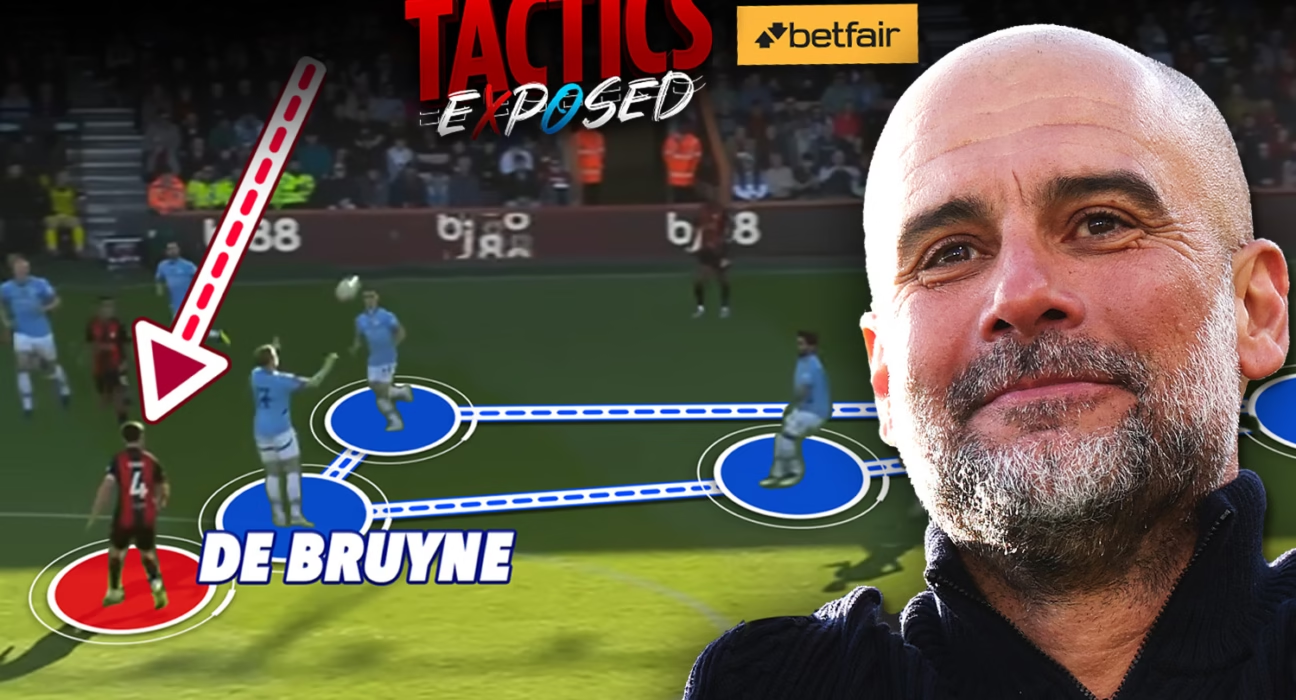
The inverted full-back tactic is a hallmark. Full-backs like Kyle Walker or John Stones step into midfield, creating a 3-2-4-1 shape in possession. This overloads central areas and increases passing options in Zone 14, the central attacking zone. The Athletic‘s Sam Lee and Sky Sports‘ Adam Bate have provided data analysis showing how this innovation confuses opponents and creates numerical advantages.
The false nine role is another key element. In the treble-winning 2022-23 season, Kevin De Bruyne or Ilkay Gündoğan often played this role, dropping deep to link play. Even Erling Haaland adapted to a more vertical false nine system, as highlighted by Stats Perform / Opta data. This flexibility allows City to morph between attacking shapes seamlessly.

A high defensive line is essential for pressing. Opta data confirms City held the highest defensive line in the Premier League, compressing the pitch and reducing opponent passing accuracy. The Guardian‘s Jonathan Wilson notes this is a direct expression of Guardiola’s risk-reward philosophy, daring opponents to beat them over the top.
Key features of the Manchester City playing style include:
- Full-backs invert to create midfield overloads.
- A false nine drops deep to disrupt defensive structures.
- Defense pushes high to squeeze the pitch and force errors.
- Goalkeepers play a key role in building attacks from the back.
Innovation on the Pitch – How Guardiola Changed the Game
The Guardiola football innovations start with the goalkeeper as an outfield player. Guardiola required first-touch passing accuracy above 85% from goalkeepers like Victor Valdés, Marc ter Stegen, and Ederson—a standard previously unheard of. FIFA Technical Reports from 2010 to 2015 document how this changed goalkeeper training globally.

The Juego de Posición system is built on “triangles and diamond” patterns that maximize passing lanes. The Guardian‘s Barney Ronay has described how these patterns create infinite passing options, making it nearly impossible for opponents to press effectively. This system is now taught in professional academies, including Manchester City’s own academy.
Guardiola has also invented specific tactical tweaks for opponents. For example, he used a “4-2-4” with no recognized full-backs (like deploying Yaya Touré as a center-back in possession) to counter high-pressing teams such as Jürgen Klopp’s Liverpool. BBC Sport‘s Guillem Balagué has detailed these tactical adaptations in his analyses.

These innovations have forced a shift in modern football tactics globally. Top managers like Mikel Arteta, Xavi, and Julian Nagelsmann explicitly cite Guardiola’s playbook. Mundo Deportivo has published tactical analyses showing how Arteta’s Arsenal and Xavi’s Barcelona mirror Guardiola’s principles.
List of key Guardiola football innovations:
- Goalkeeper as a sweeper-keeper with high passing accuracy demands.
- Triangular and diamond passing patterns for ball circulation.
- Variable formations like 4-2-4 to counter specific opponents.
- Integration of data analytics into tactical decision-making.
The Legacy of a Tactician
The legacy of Pep Guardiola tactics is evident in how every component—from goalkeeper distribution to false nine positioning—is designed to solve a specific problem: breaking down a low block or punishing a high press. FourFourTwo‘s 2024 retrospective noted no manager has so thoroughly integrated data, psychology, and tactics into a single, replicable system. FourFourTwo‘s retrospective highlights this as a turning point in football history.
Guardiola has created a generation of coaches who implement variations of his system. Mikel Arteta at Arsenal, Xavi at Barcelona, and Vincent Kompany at Bayern Munich all draw from his methods. His legacy is described as “the new orthodoxy” of European football, where positional play is now the default language of elite tactics. The Times‘ Matt Dickinson and L’Équipe have both published analytical reviews confirming this impact.
Even as opponents find ways to counter his methods—using a mid-block and bypassing the press—Guardiola continues to adapt. His principles, especially variable defensive lines and hybrid roles, will define the next decade of tactical evolution. The Athletic‘s Michael Cox argues that Guardiola’s ability to evolve ensures his influence will endure.
The Pep Guardiola tactics are not just a style but a complete system that has permanently changed how football is played and coached. His Guardiola coaching philosophy remains the benchmark for aspiring managers, the Manchester City playing style represents the pinnacle of club-level execution, and his Guardiola football innovations continue to inspire new generations. In the context of modern football tactics, Guardiola stands alone as the architect of a revolution.
Frequently Asked Questions
- What is Pep Guardiola’s primary tactical philosophy? His Guardiola coaching philosophy is based on positional play, or Juego de Posición, which emphasizes controlling space and creating passing triangles.
- How does Manchester City’s playing style differ from other teams? The Manchester City playing style uses inverted full-backs, a high defensive line, and a false nine to dominate possession and create overloads.
- What are some of Guardiola’s key innovations? Guardiola football innovations include using the goalkeeper as an outfield player, tactical tweaks like the 4-2-4, and integrating data analytics into game plans.
- How has Guardiola influenced modern football tactics? He has shifted modern football tactics toward positional play and high pressing, with disciples like Arteta and Xavi spreading his ideas globally.