

Davos 2026 AI Safety Trends: A Critical Analysis of Global Agenda-Setting

Estimated reading time: 9 minutes
Key Takeaways
- The Davos 2026 summit marked a shift from abstract AI safety principles to practical, interaction-focused safeguards, though enforcement gaps remain.
- Responsible AI deployment discussions emphasized behavioral guardrails, such as de-anthropomorphizing chatbots and privacy-minimizing defaults, to mitigate real-world harms.
- AI literacy emerged as a cornerstone for digital safety, with proposals for scalable programs in libraries, schools, and workplaces to bridge knowledge gaps.
- Independent audits for high-risk AI systems, including red-teaming and incident-sharing networks, were touted as accountability mechanisms, but face challenges in standardization and global enforcement.
- The proposal for AI classes in schools aims to build long-term resilience by teaching youth about algorithms, ethics, and critical thinking, yet risks superficiality without sustained funding and teacher training.
- Critical analysis reveals persistent gaps in global equity, binding regulations, and the cyber-AI paradox, highlighting the need for transition from proposals to binding global mechanisms.
Table of Contents
- Davos 2026 AI Safety Trends: A Critical Analysis
- Key Takeaways
- Introduction: The Davos Agenda and AI Safety
- Trend 1: Responsible AI Deployment: From Principles to Practice
- Trend 2: AI Literacy: The Foundation for Digital Safety
- Trend 3: Independent Audits: Ensuring Accountability in AI Systems
- Trend 4: AI Classes in Schools: Building Long-Term Resilience
- Synthesis: Interconnections and Critical Gaps
- Frequently Asked Questions
Introduction: The Davos Agenda and AI Safety
Each year, the World Economic Forum’s (WEF) Davos summit convenes world leaders, CEOs, and innovators to shape global responses to pressing challenges. In 2026, as artificial intelligence (AI) continues its rapid evolution, Davos positioned itself as a pivotal agenda-setter for AI safety, emphasizing the need for practical safeguards amid escalating hype.

This post provides a critical examination of the dominant AI safety narratives and proposals from Davos 2026, revealing a shift toward interaction-focused measures while highlighting persistent gaps in enforcement and global equity.
The summit’s discussions crystallized around key trends: the push for world economic forum responsible ai deployment 2026 through concrete guidelines, the emphasis on ai literacy davos summit 2026 discussions to bridge knowledge gaps, calls for independent audits for ai safety davos as accountability mechanisms, and proposals for ai classes in schools world economic forum proposal to foster early education. We will analyze these trends for their ambition versus feasibility, drawing on insights from WEF reports on AI literacy.
Here’s a preview of our analysis:
- Evolving frameworks for responsible deployment that prioritize real-world interaction risks.
- Bridging knowledge gaps via literacy programs to empower public and corporate understanding.
- Independent oversight for accountability through audits and red-teaming.
- Early education foundations with AI classes in schools to build future resilience.
- Synthesis of their interconnections and a critical assessment of remaining challenges.
Trend 1: Responsible AI Deployment: From Principles to Practice
Davos 2026 marked a clear emphasis on moving beyond abstract principles to concrete action in AI safety. The discussions on world economic forum responsible ai deployment 2026 defined responsible AI deployment as shifting from high-level ethical guidelines to actionable implementation plans that prioritize interaction-level risks over foundational models alone. As noted in a WEF story on AI literacy, this approach aims to mitigate harms where AI meets users directly.

For a deeper exploration of ethical implementation frameworks, see our guide on Ethical AI Deployment Strategies for 2025: Crucial Trends, Challenges, and Best Practices.
The proposed guidelines include:
- Embedding behavioral guardrails in AI interfaces: For instance, de-anthropomorphizing chatbots to curb false trust by avoiding human-like personas that build undue emotional reliance.
- Privacy-minimizing defaults: Such as automatic opt-outs for data sharing to protect user information.
- Uncertainty signals: Like “this response was generated by AI” to indicate limitations and prevent overreliance.
- Human-in-the-loop escalation: Routing high-stakes queries, such as complex medical or financial decisions, to human oversight to ensure safety.
These measures are designed to address harms like biased hiring algorithms or deceptive chatbots, as highlighted in the WEF story.

To understand the critical strategies for eliminating bias and ensuring fairness in such systems, read our analysis on Explosive AI Fairness & Ethics: Critical Strategies to Eliminate Bias and Ensure Transparent Accountability.
Critically, the summit also assessed emerging practices:
- Provenance labels: Digital markers that verify AI output origins to reduce overreliance on unverified content.
- Red-team tests: Simulated adversarial attacks to expose vulnerabilities before deployment.
- Publishing safety playbooks: Public documents outlining risk mitigation strategies for transparency.
However, these initiatives often lack specificity on enforcement, with calls for regulators to ensure accessible redress mechanisms—user-friendly complaint systems for those harmed by AI. This gap is noted in the same WEF story.
A key debate centered on the role of governments versus corporations. While public-private alignment was touted for cyber resilience—such as shared threat intelligence—critiques pointed to voluntary cooperation’s risks of “free-rider problems,” where companies benefit without contributing due to competitive pressures hindering data-sharing. This issue is explored in a WEF story on cyber resilience.
Critical perspective: This framework advances stewardship but underemphasizes equitable liability, favoring corporate-led innovation over stringent oversight. Tying back to davos 2026 ai safety trends critical analysis, we must question if these measures sufficiently address global implementation gaps, especially in regions with weaker regulations. References: WEF on AI literacy and WEF on cyber resilience.
Trend 2: AI Literacy: The Foundation for Digital Safety
Responsible deployment requires widespread understanding, leading into literacy as a foundational enabler. The ai literacy davos summit 2026 discussions defined AI literacy as public and corporate understanding of AI’s mechanics, benefits, and harms—essential for digital safety given AI’s outpacing adoption. Risks to vulnerable groups from opaque probabilistic models (AI systems that output predictions based on statistical probabilities rather than certainties) make this urgent, as cited in this WEF story.
For a broad look at how AI is reshaping daily life and why literacy matters, explore How AI is Changing the World: Transforming Your Everyday Life.
Proposed initiatives focus on scalable programs via:
- Libraries, schools, workplaces, and community centers: Offering accessible education hubs.
- Role-plays: Simulated AI interaction scenarios to practice decision-making.
- “Escalation maps”: Guides on when and how to consult professionals for AI limitations.
- Training on AI basics: Covering concepts like algorithms, data bias, and ethical use.
These efforts mirror past computer literacy classes that democratized tech access, as noted in the WEF story.
To see AI literacy in action through a popular domain, consider how AI in Content Creation: Revolutionize Your Strategy with Powerful AI Assistants and SEO Copywriting demonstrates practical tools and understanding.
The Global Coalition for Digital Safety’s role was highlighted in bridging AI technical experts with trust/safety communities, focusing on content provenance (verifying information origins) and regulations discussed at Davos, per the WEF story.
Critical evaluation: Challenges include standardization across borders and sectors, and nascent progress uneven between policy rhetoric and execution. For example, initiatives are slower in the Global South due to resource gaps, potentially exacerbating digital divides. Yet, literacy promises to reduce parasocial trust—unhealthy emotional bonds with always-available AI. References: WEF on AI literacy and WEF on energy security.
In summary, AI literacy is a safety cornerstone, but scaling demands coordinated investment beyond rhetoric. This ties to davos 2026 ai safety trends critical analysis by assessing feasibility in diverse global contexts, as cited in the WEF story.
Trend 3: Independent Audits: Ensuring Accountability in AI Systems
Literacy alone isn’t enough without accountability mechanisms, introducing oversight as the enforcement layer. The discussions on independent audits for ai safety davos defined them as third-party reviews mandated by regulators for high-risk AI systems—those with potential for significant harm like autonomous decision-making in healthcare or finance. These include routine red-teaming (stress-testing for failures) and cross-sector incident-sharing networks (databases of AI mishaps for collective learning), as per this WEF story.
For context on the evolving regulatory landscape that enables such audits, read Understanding New AI Regulations: A Crucial Guide for Businesses Navigating Global Rules and the Impact of the EU AI Act.
Proposed models include:
- “Guardian agents”: Specialized AI that monitors other AIs for anomalies in real-time, like detecting erratic outputs.
- Accessible redress systems: User-friendly platforms for reporting issues and seeking remedies.
- Treating threat data as a collective asset: Sharing information to counter AI-amplified cyber risks such as phishing or IP theft.

These ideas are supported by WEF on AI literacy and WEF on cyber resilience.
Debate on feasibility: While technically viable via real-time anomaly detection, audits face challenges in standardization, enforcement, and proprietary concerns—companies protecting trade secrets. Experiments like “safe-harbour” provisions (legal protections for compliant firms) or insurance pools (shared risk funds) were discussed, as noted in the cyber resilience story.
Critical analysis: This trend balances innovation and safety by focusing audits on interactions rather than core tech. However, global enforcement lags without binding compacts, risking diffused accountability amid cyber-AI paradoxes—where AI both enhances and amplifies threats. This ties to davos 2026 ai safety trends critical analysis and world economic forum responsible ai deployment 2026, citing WEF on AI literacy and WEF on cyber resilience.
Trend 4: AI Classes in Schools: Building Long-Term Resilience
Linking to long-term sustainability, early education forms the base for literacy and responsible use. The ai classes in schools world economic forum proposal involves integrating AI education into K-12 curricula to teach youth how to treat AI as a tool. This includes explaining algorithms (step-by-step computational processes), ethics (fairness and moral use), critical thinking (questioning outputs), where it helps (e.g., personalized learning), and harms like bias (skewed data leading to unfair results) or deception, as cited in this WEF story.
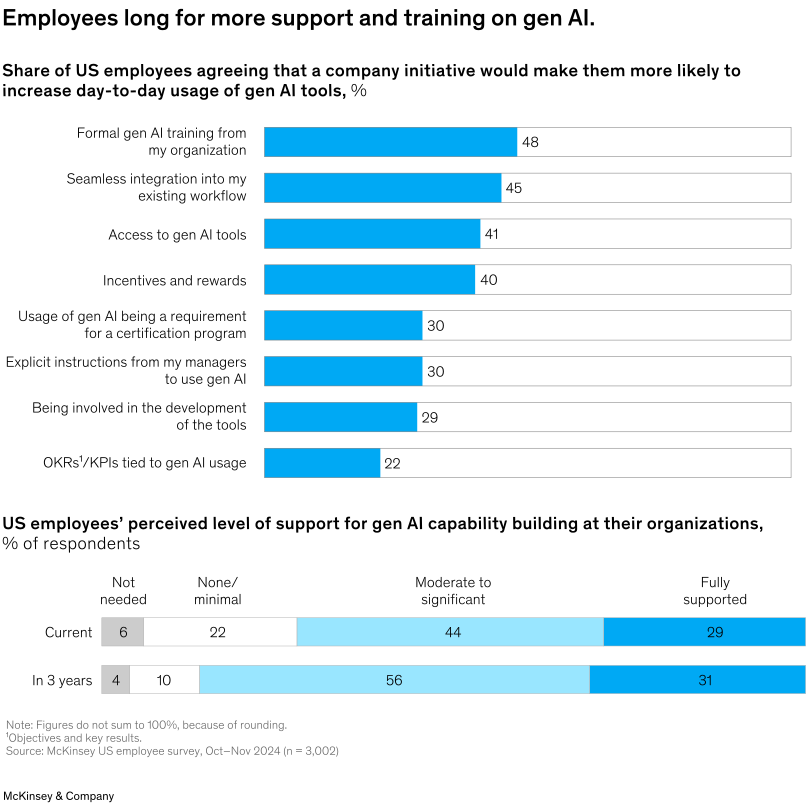
Rationale: Closing early understanding gaps prepares for AI-mediated interactions amid rising loneliness crises and rapid tech adoption. It builds verification behaviors like cross-checking AI responses, akin to computer literacy’s evolution, per the WEF story.
Proposed content covers:
- Basics of probabilistic models: Understanding AI’s statistical nature that causes occasional errors.
- Practical skills: Using AI tools responsibly and ethically.
Hurdles include:
- Teacher training: Upskilling educators on AI basics.
- Resource allocation: Devices and funding, especially in underserved regions.
- Curriculum development: Integrating AI without overwhelming core subjects.
- Avoiding overhyping amid energy constraints for AI infrastructure, as noted in WEF on AI literacy and WEF on energy security.

Critical evaluation: This proposal is proactive for future-literate societies but risks superficiality without sustained funding. It is challenged by global disparities, connecting to ai literacy davos summit 2026 discussions, as cited in the WEF story.
Synthesis: Interconnections and Critical Gaps
Synthesizing the trends, we see clear interconnections: ai literacy davos summit 2026 discussions enables world economic forum responsible ai deployment 2026, independent audits for ai safety davos enforce alignment, and ai classes in schools world economic forum proposal build long-term resilience. Together, they prioritize interaction harms via signals, guardrails, and coalitions, within the broader davos 2026 ai safety trends critical analysis, as referenced in WEF on AI literacy.

Critical assessment of gaps: The discussions were overly optimistic on timelines, ignoring enforcement hurdles, free-rider risks, Global South inequities, and cyber-AI paradoxes (AI both enhancing and amplifying threats).
These issues are highlighted in WEF on AI literacy, WEF on cyber resilience, and WEF on energy security.
Final thought: The overarching importance lies in transitioning from Davos 2026 proposals to binding global mechanisms for AI safety, ensuring AI serves humanity without unchecked risks. We call on readers to stay informed on these trends, advocate for literacy in their communities, and share this analysis to spark broader discussions on responsible AI futures.
Frequently Asked Questions
What were the key AI safety trends from Davos 2026?
The key trends included responsible AI deployment with practical guidelines, AI literacy programs, independent audits for high-risk systems, and proposals for AI classes in schools. These focus on interaction-level safeguards and accountability.
How does AI literacy contribute to digital safety?
AI literacy empowers users to understand AI mechanics, benefits, and harms, reducing overreliance and enabling informed decisions. It’s essential for mitigating risks like bias and deception, especially for vulnerable groups.
What are independent audits for AI safety, and why are they important?
Independent audits are third-party reviews of high-risk AI systems, including red-teaming and incident-sharing. They ensure accountability, expose vulnerabilities, and promote transparency, though enforcement challenges remain.
What are the challenges in implementing AI classes in schools?
Challenges include teacher training, resource allocation, curriculum integration, and addressing global disparities. Without sustained funding, such initiatives risk being superficial.
What gaps persist in the Davos 2026 AI safety proposals?
Gaps include lack of binding enforcement, free-rider problems in public-private cooperation, global equity issues, and the cyber-AI paradox. These highlight the need for stronger regulatory frameworks.